

AI for Seniors.
The Good, Bad, and Slightly Scary
Benefits and Risks You Need to Know

Introduction to AI for Seniors
Hey there, future retirees and curious life-lovers.
Retirement is supposed to be the chapter where you finally get to breathe a little.
No more alarm clocks screaming at you before sunrise.
No more pretending to enjoy office small talk about printer jams.
And no more sitting in traffic wondering why everyone forgot how lanes work.
However, just as you are stepping into this new stage, another big thing has entered the room wearing shiny shoes and a slightly mysterious grin.
That thing is artificial intelligence.
Now, before your eyes glaze over, let’s keep this simple.
AI is not just robots taking over the world like in a sci-fi movie.
In everyday life, AI is the smart technology behind things like voice assistants, health apps, online recommendations, fraud alerts, travel tools, and even those apps that fix your spelling before you send a message to your grandkids.
In other words, AI for seniors is not about becoming a tech wizard overnight.
It is about learning how this technology can make life easier, safer, and sometimes a little more fun.
AI for Seniors
What Does AI Actually Mean?
Artificial intelligence sounds fancy, but the basic idea is pretty simple.
AI is technology that can learn patterns, make suggestions, answer questions, sort information, and help with tasks that normally need human thinking.
It does not “think” exactly like a person, but it can process huge amounts of information quickly.
For example, when your phone suggests the next word in a text message, that is AI helping out.
When a shopping site remembers what you like, that is AI doing its thing.
When a map app tells you there is traffic ahead and suggests another route, AI is quietly working in the background.
So, when people talk about artificial intelligence for retirees, they are usually talking about tools that can support everyday life.
These tools can help with health, home safety, communication, hobbies, planning, learning, and even staying independent longer.
Of course, AI is not magic.
It can be helpful, but it can also be confusing, invasive, or just plain wrong sometimes.
That is why it is worth understanding both sides.
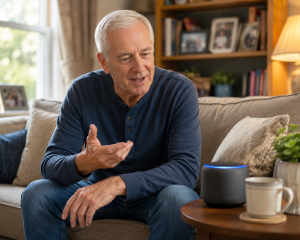
AI for Seniors
Why It Matters in Retirement
Retirement changes your daily rhythm.
Suddenly, you may have more time, more freedom, and more decisions to make.
For retirees who are curious about simple online opportunities, this guide to best affiliate programs 2025 gives a helpful next step, especially if you want to see how AI can make things easier without turning retirement into another full-time job.
You may also be managing health needs, planning your budget more carefully, staying in touch with family, or looking for ways to keep your mind active.
This is where AI for seniors can be useful.
For example, AI can remind you to take medication, help you track appointments, suggest recipes based on what is in your kitchen, or help you write a message when you cannot quite find the right words.
In addition, AI can help you learn new things.
Maybe you want to understand photography, grow better tomatoes, research family history, or finally figure out how to use that tablet someone bought you three birthdays ago.
Meanwhile, AI can also give you more confidence online.
It can explain confusing terms, help spot suspicious messages, and guide you through basic digital tasks.
However, retirement should not become a technology obstacle course.
AI should support your life, not make you feel like you need a college degree in robot whispering.
The Benefits of AI for Seniors in Everyday Life
The benefits of AI for seniors are easiest to understand when you picture normal daily moments.
Imagine waking up and asking a voice assistant about the weather.
It tells you whether you need a coat, an umbrella, or the emotional strength to face sideways rain.
After that, you check your calendar.
An app reminds you about a doctor’s appointment, your grandchild’s birthday, and the fact that you promised to meet a friend for coffee.
Later, you want to cook something healthy.
Instead of staring into the fridge like it owes you answers, you ask an AI tool for a recipe using eggs, spinach, and leftover chicken.
Suddenly, dinner has a plan.
Then, in the evening, you want to send a nice note to your family.
AI can help you polish the message so it sounds warm, clear, and not like it was written during a wrestling match with autocorrect.
Clearly, AI can save time.
More importantly, it can reduce the little daily frustrations that chip away at your patience.

AI for Seniors and Health Monitoring
Health is one of the biggest areas where AI for seniors can be helpful.
Wearable devices, smart watches, and health apps can track steps, sleep, heart rate, and movement.
Some can even detect unusual patterns and encourage you to check in with a doctor if something seems off.
For example, a smartwatch may notice that your heart rate looks different than usual.
It will not replace a medical professional, but it may give you a helpful nudge to pay attention.
In addition, AI-powered reminders can help with medication schedules.
This is especially useful if you take more than one pill each day and your medicine cabinet is starting to look like a tiny pharmacy.
On the other hand, it is important not to panic every time an app sends an alert.
Technology can make mistakes.
A watch is helpful, but it is not your doctor, your nurse, or your wise friend who always tells you to drink more water.
So, use AI health tools as support, not final answers.

AI for Seniors and Staying Connected
One of the hidden challenges of retirement can be loneliness.
You may no longer have the built-in social contact that came from work.
Friends may move away.
Family may be busy.
And sometimes, the house can feel a little too quiet.
Thankfully, AI for seniors can make staying connected easier.
Video calling tools can help you see loved ones face-to-face, even if they live far away.
Social apps can suggest groups, events, or communities based on your interests.
AI can also help you write messages, organize photos, and remember important dates.
Meanwhile, if you ever decide to share tips, stories, or helpful resources online, learning how to build an email list for beginners can help you stay connected with readers without relying only on social media.
For example, if your grandson loves dinosaurs and you want to send him a fun message, AI can help you come up with a playful note.
If your daughter is having a stressful week, AI can help you shape a caring message that says what you mean without sounding too formal.
Meanwhile, smart speakers can make calls with voice commands.
That can be especially useful if typing on a small screen feels like trying to play piano with mittens on.
AI for Seniors and Financial Confidence
Money matters do not disappear in retirement.
In fact, they often become more important.
AI can help organize spending, track bills, spot unusual account activity, and explain basic financial terms.
Some budgeting tools can group expenses automatically, making it easier to see where your money goes each month.
For example, you might discover that your “small treats” category has somehow grown into a creature with its own postcode.
Coffee, subscriptions, snacks, and little online purchases can add up quickly.
In addition, AI tools may help you compare prices, plan shopping lists, and avoid duplicate purchases.
That is handy when you are trying to stretch your retirement income without feeling like every decision requires a calculator and a dramatic sigh.
However, be careful with financial advice from AI.
It can explain general ideas, but it should not replace a qualified professional.
Also, never share private banking details, passwords, or personal identity information with random tools.
If something feels pushy, urgent, or too good to be true, pause before acting.
AI Risks for Older Adults. The Not-So-Fun Bit
Now let’s talk about the AI risks for older adults.
Yes, AI can be useful. However, there are real concerns too.
First, privacy matters.
Many AI tools collect data to work better.
That data might include your habits, interests, location, voice, messages, or health information.
While some companies handle this responsibly, others may not be as careful as you would like.
Second, AI can give wrong answers.
It may sound confident even when it is completely mistaken.
Think of it like a person at a dinner party who speaks loudly about a topic they barely understand.
Third, scammers are using AI too.
Fake messages, fake voices, fake images, and fake support chats can look more convincing now than ever before.
Because of this, older adults need to be extra cautious.
Not because seniors are “bad at tech,” but because scammers often target people they believe may be trusting, polite, or less familiar with digital tricks.

AI for Seniors and Privacy Concerns
Privacy is one of the biggest worries around AI for seniors.
After all, nobody wants their personal life treated like a garage sale where everything is up for grabs.
Before using an AI tool, check what information it asks for.
Does it really need your full name, address, date of birth, and personal records?
Sometimes it might, but often it does not.
For example, if you are asking an AI tool to suggest dinner ideas, it does not need your medical history or bank details.
If you are using a health app, it may need some personal information, but you should still check the privacy settings.
In addition, avoid putting sensitive information into general AI chat tools.
Do not paste in passwords, bank statements, tax documents, private medical records, or personal identification numbers.
A good rule is this.
If you would not hand it to a stranger in a coffee shop, do not type it into a random tool online.
AI for Seniors and Tech Overwhelm
Technology can feel overwhelming, especially when every device seems to update itself right when you finally learned how it worked.
One day, the button is blue.
Next day, it has moved, changed shape, and apparently joined a witness protection program.
That is why AI for seniors should be introduced slowly.
Start with one simple tool.
For example, try a voice assistant, a medication reminder, or an AI writing helper.
Use it for one small task until you feel comfortable.
After that, add another task.
Maybe ask AI to explain a confusing email.
Then try using it to create a shopping list.
Later, you might ask it for travel ideas, hobby tips, or help organizing photos.
The key is not to learn everything at once.
Nobody becomes confident by being buried under twenty apps and a password notebook that looks like ancient scripture.
Instead, build confidence one small win at a time.
Artificial Intelligence for Retirees at Home
Artificial intelligence for retirees can be especially useful around the home.
Smart home devices can turn lights on and off, adjust the thermostat, remind you about appointments, and even help with safety.
Some systems can detect falls, unusual movement, or whether a door has been left open.
For example, if you wake up at night, motion-sensor lights can help you move safely without fumbling around in the dark.
That alone can prevent a lot of toe-stubbing drama.
In addition, smart speakers can answer simple questions, play music, read audiobooks, set timers, or call family members.
However, smart homes do not need to be complicated.
You do not have to turn your living room into mission control.
Start with practical tools.
A smart plug, voice assistant, or doorbell camera may be enough.
The goal is comfort and safety, not making your toaster smarter than your cousin.
AI for Seniors and Travel Planning
Retirement can be a great time to travel.
Whether you dream of a beach holiday, a scenic train ride, or visiting family across the country, AI can help make planning easier.
For example, AI can suggest destinations based on your budget, mobility needs, weather preferences, and interests.
It can help compare routes, build packing lists, and create gentle travel schedules that do not cram twelve activities into one exhausting afternoon.
In addition, AI translation tools can help when visiting places where you do not speak the language.
You can translate menus, signs, and simple conversations.
However, double-check important details.
Flight times, hotel policies, passport rules, and medical requirements should always be confirmed through official sources or trusted providers.
AI is great for planning.
Still, you do not want to arrive at the airport with a suitcase full of confidence and a ticket for the wrong Tuesday.
AI for Seniors and Hobbies
One of the loveliest uses of AI for seniors is hobby support.
Retirement gives you more room to explore things that may have been pushed aside for years.
Gardening, painting, writing, cooking, music, woodworking, photography, genealogy, and crafting can all become more fun with AI.
For example, a gardener can ask AI why tomato leaves are turning yellow.
A writer can ask for help developing a story idea.
A cook can ask for low-salt dinner ideas.
A photographer can learn simple lighting tips.
Meanwhile, someone interested in family history can use AI to organize research questions, create interview prompts, or turn old family notes into readable stories.
Better still, if a hobby turns into something you would like to teach others, this guide on how to monetize your knowledge explains how everyday experience can become helpful online
In addition, AI can help you learn at your own pace.
There is no classroom pressure, no test, and no teenager rolling their eyes because you asked where the settings button went.
You can ask the same question five times if needed.
And if you enjoy sharing what you learn, this guide on how to build an audience from scratch can help you turn small, helpful posts into a real community over time.
AI will not sigh.
That alone is a blessing.

AI for Seniors and Online Learning
Learning does not stop after retirement.
Actually, retirement can be one of the best times to learn because you are doing it for yourself, not because a boss, teacher, or workplace training video told you to.
AI for seniors can make online learning feel less intimidating.
For example, you can ask AI to explain a topic in simple words.
You can ask for examples, summaries, practice questions, or step-by-step instructions.
If something does not make sense, you can ask it to explain again using a different comparison.
Maybe you want to learn Spanish, understand digital photos, explore creative writing, or study online business basics through something like Internet Profit Success.
If that last idea made your ears perk up, this simple guide explaining what is online business is a great beginner-friendly place to start before choosing any path.
AI can help break the information into smaller, friendlier chunks.
And if you want to see how people use smart tools for content ideas, writing help, and simple planning, this guide to AI tools for affiliate marketers shows practical examples without making your brain feel like mashed potatoes.
However, learning still takes patience.
AI can guide you, but it cannot do the practice for you.
Think of it like a walking stick on a trail.
It helps with balance, but you still have to move your feet.
AI for Seniors and Scams
Scams are getting sneakier, and AI is making some of them look very convincing.
For example, scammers can use AI to write polished emails that look real.
They may create fake customer support chats, fake prize messages, or even voice recordings that sound like someone you know.
Because of this, it is important to slow down.
If a message says you must act immediately, pause.
If someone asks for gift cards, bank details, passwords, or remote access to your computer, stop.
If a family member suddenly messages asking for urgent help, call them directly using a number you already know.
In addition, watch for odd details.
A message may sound close to normal but still feel slightly off.
Trust that feeling.
AI risks for older adults are not about intelligence.
Likewise, if you ever use AI to publish advice or recommendations, learning how to build credibility online matters because trust beats robotic noise every single time.
They are about criminals using better tools.
So, your best defense is caution, patience, and a healthy dose of “hang on a minute.”
AI for Seniors and Independence
Independence matters.
Most people want to stay in control of their own lives for as long as possible.
AI for seniors can support that goal by helping with reminders, routines, safety checks, transportation planning, communication, and everyday problem-solving.
For example, AI can help someone remember appointments, manage grocery lists, or follow exercise routines.
It can also assist with reading small text, dictating messages, or finding information quickly.
In addition, AI can make it easier to ask for help without feeling like you are bothering someone.
Sometimes you just need a quick answer, not a full family meeting.
However, independence does not mean doing everything alone.
Technology works best when combined with human support.
So, let AI handle small tasks, but keep real people in your circle.
Friends, family, doctors, neighbors, and community groups still matter deeply.
No app can replace a warm laugh, a kind visit, or someone bringing soup when you feel lousy.
AI for Seniors and the Dependency Dilemma
Here is the tricky part.
AI can make life easier, but it can also make us a bit lazy if we are not careful.
For example, if AI always writes your messages, you may stop trusting your own words.
If AI always gives directions, you may stop paying attention to where you are going.
If AI answers every question, you may forget to check whether the answer makes sense.
Therefore, balance is important.
Use AI as a helper, not a boss.
Let it support your thinking, but do not let it replace your judgment.
A simple way to stay balanced is to ask yourself, “Could I still do this without AI if I had to?”
If the answer is yes, you are probably fine.
If the answer is no, it may be time to practice the skill yourself once in a while.
After all, convenience is lovely.
Total dependence, on the other hand, can turn your brain into a couch potato wearing slippers.
AI for Seniors. How to Get Started Safely
Getting started with AI does not need to be dramatic.
You do not need to buy every gadget, install every app, or understand every technical term.
Instead, begin with one everyday problem you would like to solve.
In addition, if you are testing online tools on a small budget, these free marketing tools for new online marketers can help you experiment before paying for anything fancy.
For example, maybe you forget appointments.
Start with a calendar reminder tool.
Maybe typing is difficult.
Try voice dictation.
Maybe cooking feels repetitive.
Use AI to suggest simple meals.
Next, ask a trusted person to help you set up privacy settings.
This could be a family member, friend, local class instructor, or community tech helper.
In addition, write down your passwords safely using a trusted method.
Do not reuse the same password everywhere, even if it is your dog’s name plus the year you got married.
Scammers can guess more than you think.
Finally, give yourself permission to be a beginner.
Everyone starts there. Even the so-called experts have clicked the wrong button and muttered rude things at a screen.
AI for Seniors and Choosing the Right Tools
Not every AI tool is worth your time.
Some are useful. Others are confusing, expensive, or stuffed with features you will never use.
When choosing AI for seniors, keep it practical.
Ask what problem the tool solves.
Does it help with health, safety, communication, learning, planning, or entertainment?
If not, you may not need it.
Also, look for tools with simple instructions, clear privacy settings, and good support.
Avoid anything that pressures you to upgrade constantly or makes cancellation feel like escaping a maze.
In addition, be careful with tools that promise miracle results.
AI can help you write, plan, learn, and organize, but it cannot fix every problem overnight.
A good tool should feel like a helpful assistant.
It should not make you feel confused, rushed, or trapped.
If something feels too complicated, move on.
Life is short, and retirement is not the time to argue with a badly designed app.
AI for Seniors and Family Conversations
AI can be a great topic to discuss with family.
Instead of waiting until there is a problem, talk about how you want to use technology.
Explain what tools you are trying, what concerns you have, and where you may need support.
For example, you might ask a family member to help you review privacy settings once a month.
You could also create a family password phrase for emergencies, especially now that fake voice scams are becoming more believable.
In addition, talk about boundaries.
Maybe you want help setting things up, but you do not want someone taking over your devices like they are defusing a bomb.
Meanwhile, younger family members should remember that patience matters.
Nobody enjoys being treated like they are silly just because they did not grow up tapping glass screens.
AI for seniors works best when it creates confidence, not embarrassment.
A kind explanation can go a long way.
AI for Seniors. Simple Daily Uses to Try
There are many easy ways to test AI without feeling overwhelmed.
You could ask for a dinner idea based on what is already in your kitchen.
You could ask for a simple stretching routine.
Or you might request a packing list for a weekend trip or a clear explanation of a confusing letter.
For example, if you want to turn those simple AI-assisted ideas into useful blog posts or social updates, these content marketing strategies for beginners can keep the process simple and focused.
In addition, you can use AI to help write birthday messages, organize household tasks, create hobby plans, or brainstorm questions for your doctor.
Another useful idea is asking AI to simplify complicated information.
For example, if you are reading about a new phone plan, insurance letter, or medication leaflet, AI can help explain the general meaning in plain language.
However, always double-check anything important.
AI is helpful, but it is not perfect.
Think of it like a friendly neighbor who knows a lot but occasionally gets the day of trash collection wrong.
Useful, yes. Infallible, absolutely not.
AI for Seniors. The Human Side of Technology
The biggest mistake people make with AI is thinking it is only about machines.
Really, AI for seniors is about people.
It is about helping people stay connected, informed, independent, creative, and safe.
For example, a reminder app is not just a reminder app.
It may help someone feel more in control of their day.
A video call tool is not just software.
It may let a grandparent see a child’s missing tooth grin from hundreds of miles away.
In addition, AI writing help is not just about words.
It can help someone express love, thanks, sympathy, or encouragement when the right sentence will not come easily.
Of course, technology should never replace real relationships.
It should support them.
So, use AI to make life easier, but keep showing up for people.
In addition, if you start sharing your AI tips, retirement lessons, or helpful stories online, these free traffic strategies can help more people discover your content without jumping straight into paid ads.
Send the message.
Make the call.
Meet for coffee.
Laugh at the silly photo.
Share the story one more time.

AI for Seniors. Final Thoughts
AI is not perfect, and it is not going away.
For seniors and soon-to-be retirees, that can feel exciting and annoying at the same time.
On one hand, AI can help with daily tasks, health reminders, staying connected, travel planning, hobbies, learning, and home safety.
On the other hand, there are real concerns.
Privacy matters.
Scams are getting smarter.
Wrong answers can sound convincing.
And too much dependence can make simple tasks feel harder than they should.
However, the best path is not fear.
It is cautious curiosity.
Start small.
Learn slowly.
Ask questions.
Protect your information.
Double-check important details.
Most of all, remember that you are in charge.
AI for seniors should be like a helpful tool in the garage.
Handy when needed, but not something that runs the whole house.
Retirement is still your adventure.
AI can carry a few bags, hold the map, and maybe remind you where you put your glasses.
But you still get to choose the road.
You can of course choose to supplement your income by using AI in an online business.
Check out these 5 Free Videos Now.
