
7 Sales Funnels for Beginners
That Actually Work
Beginners Can Build These Fast

Introduction to Sales Funnels for Beginners
Sales funnels for beginners can sound way more complicated than they really are.
The phrase alone can make you picture giant flowcharts, expensive software, confusing buttons, and some tech wizard named Dave who somehow knows what every setting does.
Thankfully, a sales funnel is not some mysterious machine hidden behind a velvet rope.
At its core, a funnel is simply a step-by-step path that guides someone from “Who are you?” to “Okay, I’m interested.”
That’s it.
In online business, people rarely see your content once and immediately take action.
Usually, they need a little warm-up first.
They need to notice you, trust you, understand what you help with, and feel like the next step makes sense.
A good funnel does exactly that.
Instead of throwing random posts, pages, emails, and offers into the digital universe and hoping something sticks, you create a clear journey.
Even better, sales funnels for beginners do not need to be fancy.
In fact, simple is often better.
A clear lead magnet funnel, a helpful email sequence, a short course, or even a simple challenge can work beautifully when it is built around real value.
So, let’s walk through seven simple funnel ideas you can use, even if you are still new, slightly confused, and running mostly on coffee.
What Sales Funnels for Beginners Really Mean
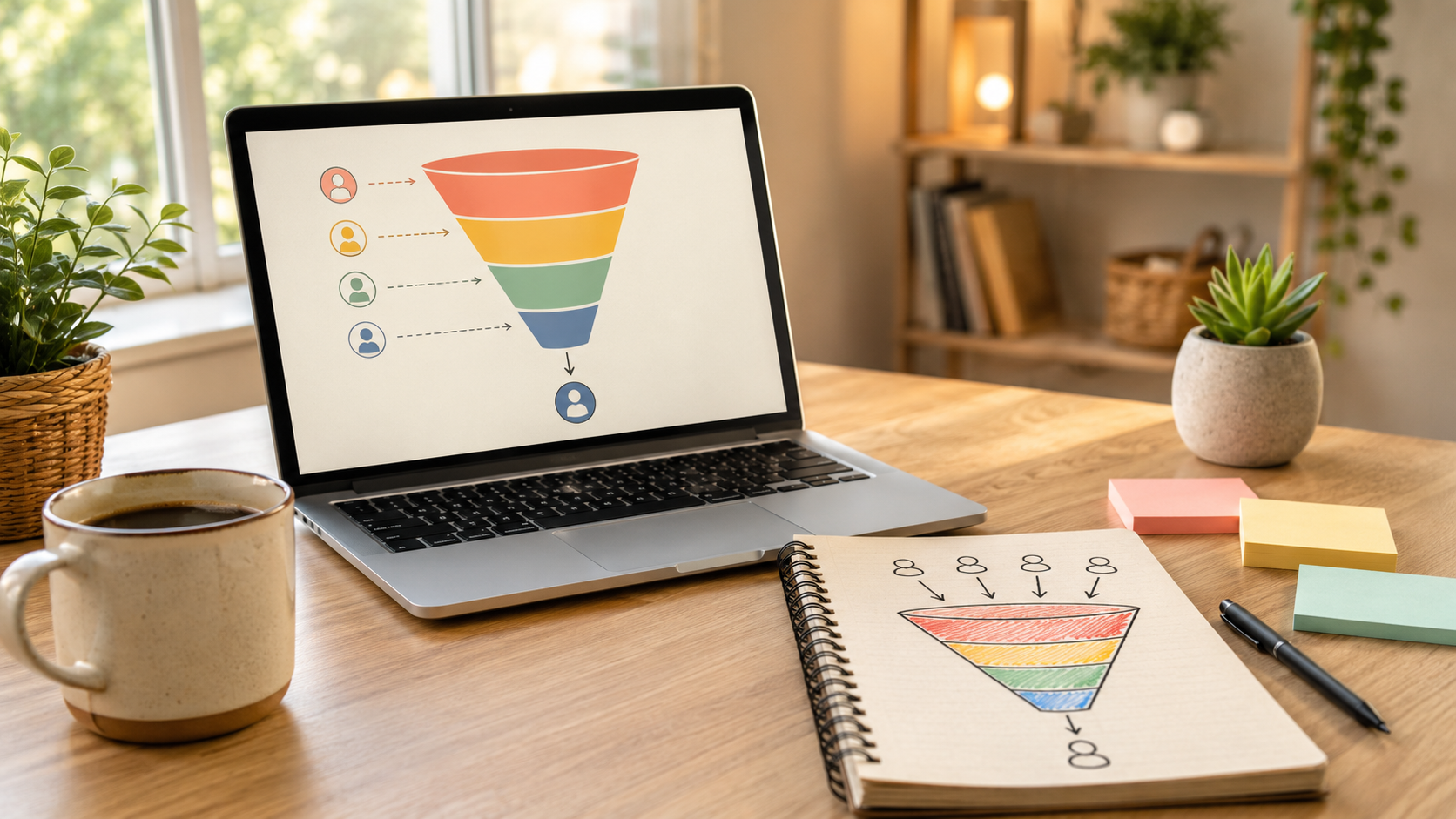
Sales funnels for beginners are just simple systems that help turn attention into action.
Someone discovers your content.
Then they take a small step, such as joining your email list.
After that, they receive more helpful information.
Eventually, they may decide to take a bigger step, such as checking out a product, training, tool, or service.
That journey is the funnel.
The reason it is called a funnel is because not everyone who enters at the top will continue to the bottom.
Lots of people may see your post.
Fewer people will visit your page.
Even fewer will join your list.
Finally, a smaller group may take the action you want.
That is completely normal.
However, without a funnel, you are often relying on luck.
With a funnel, you are guiding people in a more organized way.
Think of it like inviting someone into your house.
You probably would not shove a plate of lasagna into their hands before saying hello.
First, you welcome them.
Then you make them comfortable.
After that, maybe you offer food.
Online funnels work the same way.
They help people feel comfortable before you ask them to do anything big.

Why Sales Funnels for Beginners Should Stay Simple
One of the biggest mistakes new marketers make is trying to build a funnel that looks like it belongs inside a NASA control room.
There are too many pages.
There are too many buttons.
There are too many emails.
There are too many moving parts.
Before long, the whole thing feels like trying to assemble furniture with instructions written by a tired raccoon.
Simple funnels work better for beginners because they are easier to build, easier to test, and easier to improve.
You do not need a 27-step system to start.
Instead, you need one clear path.
For example, someone reads your content, signs up for your free guide, receives helpful emails, and then gets introduced to a relevant next step.
That is already a funnel.
In addition, simple funnels make it easier to see what is working.
If nobody joins your list, maybe your free resource needs a stronger benefit.
If people join but do not open your emails, perhaps your subject lines need more curiosity.
On the other hand, when your funnel has too many pieces, finding the problem becomes harder.
Start small.
Improve slowly.
Avoid building a digital spaghetti monster.
The Lead Magnet Funnel for Beginners
A lead magnet funnel is one of the best sales funnels for beginners because it starts with giving value first.
The idea is simple.
You offer something helpful in exchange for an email address.
That helpful item is called a lead magnet.
It could be a checklist, short guide, cheat sheet, template, video, worksheet, or mini training.
The key is that it solves one clear problem.
That is also why learning strong email list building strategies can help you turn a simple free resource into a real follow-up system.
For example, if your audience is new to online business, you might offer a guide called “5 Simple Steps to Start Your First Online Side Hustle.”
That feels useful.
It also feels specific.
A weak lead magnet tries to solve everything at once.
A strong lead magnet solves one small but important problem.
Once someone signs up, they receive the resource and join your email list.
If that part still feels a little techy, this guide on how to build an email list for beginners breaks the process down in a much simpler way.
From there, you can send helpful tips, personal stories, useful examples, and occasional recommendations.
This funnel works because it does not feel pushy.
You are not shouting, “Do this now!” like a person waving a sign in a parking lot.
Instead, you are saying, “Here, this might help.”
That small act builds trust.

Sales Funnels for Beginners Using Helpful Content
Content is often the top of the funnel.
That is why creating content that converts matters so much, because your posts should do more than collect likes.
That means it is the first thing people see before they decide to take another step.
For beginners, this is great news because content can be simple.
These social media content ideas for beginners can help you create simple posts that feed the top of your funnel.
A blog post, short video, social post, podcast episode, or tutorial can all attract attention.
Once you have one strong piece of content, these content repurposing strategies can help you turn it into several funnel entry points.
However, the content should not be random.
It should connect to the problem your audience wants to solve.
For example, if your audience wants to learn online business basics, your content might explain traffic, email lists, simple tools, beginner mistakes, or funnel ideas.
Then, inside that content, you invite people to take the next step.
That next step might be joining your list to get a checklist, watching a free training, or downloading a starter guide.
This is where many beginners drop the ball.
They create helpful content but forget to tell people what to do next.
As a result, readers enjoy the post and then wander away like someone leaving a snack table at a party.
Every helpful piece of content should have a simple next step.
Not a confusing one.
Not ten options.
Just one clear invitation.
Sales Funnel Examples for Beginners
Blog to Email Funnel
One of the easiest sales funnel examples for beginners is the blog to email funnel.
Here is how it works.
You write a helpful blog post around a topic your audience is already searching for.
Then, inside the post, you invite readers to join your email list for an extra resource.
For example, a blog post about beginner funnel ideas could invite readers to grab a simple funnel checklist.
That checklist should match the topic of the article.
This matters because people are more likely to sign up for something that connects directly to what they are reading.
In other words, do not write about funnel ideas and then offer a random guide about growing tomatoes.
Unless your niche is tomato funnels, which sounds messy but oddly interesting.
After someone signs up, you send a few emails that continue helping them.
One email might explain common beginner mistakes.
Another might share a simple success story.
A later email might introduce a related product or training.
This funnel is simple, but it works because it follows a natural flow.
People search for help.
They find your content.
They get more help by joining your list.
Then they keep hearing from you.
The Webinar Funnel for Beginners
A webinar funnel uses an online presentation to teach something useful and then introduce a next step.
This can be live or recorded.
For beginners, a recorded webinar may feel less stressful because you do not have to show up live each time.
You create the presentation once and use it again.
The best webinar funnels focus on one clear topic.
For example, instead of teaching “everything about online business,” you might teach “how to set up your first simple funnel.”
That feels manageable.
It also attracts people with a specific problem.
During the webinar, you provide real value.
You might explain the big picture, show common mistakes, share a simple framework, and give examples.
Then, near the end, you introduce a product, service, or training that helps people go deeper.
A good webinar is not a boring lecture.
It should feel like a helpful workshop.
Add stories.
Use simple examples.
Keep the pace moving.
Nobody wants to feel trapped in a slideshow dungeon.
In addition, make sure your registration page is clear.
Tell people what they will learn and why it matters.
The more specific the promise, the better.

Marketing Funnels for Beginners
Free Course Funnel
A free course funnel is another strong option for people who want to build trust through education.
This funnel gives your audience a short series of lessons.
The lessons can be delivered by email, video, or a private page.
Usually, a free course lasts three to seven days.
That is long enough to provide value but short enough to keep people interested.
For example, you might create a five-day course called “Build Your First Simple Funnel.”
Day one could explain the funnel concept.
Day two might cover choosing a lead magnet.
On day three could focus on landing pages.
Day four might cover follow-up emails.
Day five could explain how to send traffic.
At the end, you introduce a logical next step.
This could be a deeper training, a tool, a coaching option, or a complete system.
The free course funnel works well because it gives people quick wins.
Instead of dumping everything on them at once, you guide them step by step.
Meanwhile, your audience gets used to hearing from you.
That makes future emails feel familiar rather than random.
How Sales Funnels for Beginners Build Trust
Trust is the secret sauce in every funnel.
For a deeper look at this part, learning how to build trust with your audience can make every funnel step feel more natural and less pushy.
Without trust, even the fanciest funnel will struggle.
People do not take action just because you have a landing page.
They take action because they believe you understand their problem and can help them move forward.
For beginners, trust is built through consistency.
You show up.
You provide useful content.
Or you explain things clearly.
You do not overhype every little thing like it is the discovery of fire.
In addition, trust grows when your funnel feels helpful rather than grabby.
A lead magnet should actually be useful.
Emails should offer value, not just endless pitches.
Examples should feel realistic.
Stories should connect to real problems.
For example, if someone joins your list to learn about beginner funnels, they should receive beginner-friendly advice.
Do not immediately bury them under advanced tech terms.
That feels like inviting someone to a swimming lesson and pushing them into the deep end with a snorkel and a motivational quote.
Instead, keep things clear.
Make the next step feel safe.
Over time, that trust can turn into action.
The Tripwire Funnel for Beginners
A tripwire funnel introduces a low-cost product after someone takes a free first step.
Usually, this happens after they sign up for a lead magnet.
For example, someone downloads a free checklist.
Right after that, they see a small related product, such as a template pack, short guide, or mini course.
The goal is not to overwhelm them.
The goal is to offer a simple next step that feels useful and easy.
Tripwire funnels work because they help turn subscribers into buyers.
Even a small purchase changes the relationship.
Someone who has taken a small step may be more open to taking a bigger step later.
However, the tripwire product must be closely related to the free resource.
If your lead magnet is about building a simple funnel, your tripwire might be a funnel template kit.
That makes sense.
On the other hand, if your tripwire is about dog grooming, people may wonder if your website has been hacked by a very entrepreneurial poodle.
Keep the connection clear.
Also, avoid making the page too complicated.
Explain what the product helps with, why it is useful, and how it saves time.
Simple wins again.
Sales Funnel Examples for Beginners
The Case Study Funnel
A case study funnel uses a real or realistic example to show how a result was achieved.
This works well because people love seeing proof.
They want to know what happened, what steps were taken, and what changed afterward.
For beginners, a case study does not need to be dramatic.
It can be simple.
For example, you might show how someone created a basic lead magnet, posted helpful content, collected subscribers, and followed up by email.
The result could be more leads, more replies, or more interest in their offer.
The power comes from the story.
A strong case study usually starts with a problem.
Then it explains the steps taken.
After that, it shows the result.
Finally, it invites the reader to learn the same method.
This type of funnel works especially well when your audience feels skeptical.
Instead of just saying, “This works,” you show how it worked.
That feels more believable.
In addition, case studies help beginners visualize the process.
Abstract ideas can feel foggy.
Real examples make the path clearer.
It is like turning on headlights during a rainy Portland evening.
Suddenly, the road makes a lot more sense.
Sales Funnels for Beginners Using Challenges
Challenge funnels are fun because they get people involved.
Instead of only reading or watching, participants complete small tasks over a few days.
A challenge might last three, five, or seven days.
Each day, you give one simple action.
For example, a seven-day beginner funnel challenge might include choosing a niche, creating a lead magnet idea, writing a landing page headline, drafting emails, and planning traffic content.
The point is to help people make progress.
Not huge progress.
Just enough to feel momentum.
Challenges work because people like structure.
They also like having a clear reason to show up each day.
In addition, challenges can create a sense of community if you run them through email, social media, or a private group.
At the end of the challenge, you can introduce a related product or program.
This next step should feel like the natural continuation of what they just started.
For example, if the challenge helped them plan a funnel, the next step could help them build and launch it.
Keep the challenge simple, though.
Do not give people homework that feels like a college thesis.
Small steps create better completion.
The Email Follow-Up Funnel
An email follow-up funnel is often where the real relationship is built.
After someone joins your list, your emails help them understand you, trust you, and move toward the next step.
The first email should deliver what they requested.
That sounds obvious, but it matters.
If someone asks for a checklist, give them the checklist.
Do not make them solve a puzzle, join three platforms, and sacrifice a printer cartridge first.
After delivery, your next emails should continue the conversation.
You might share a beginner mistake.
Then you could explain a simple tip.
Later, you might tell a short story about why funnels matter.
Eventually, you introduce a helpful product or resource.
The key is balance.
If every email asks for something, people may tune out.
However, if you never make an invitation, people may not know how to move forward.
A good follow-up sequence mixes value, story, trust, and action.
For example, one email can teach.
Another can answer a common objection.
A third can share a useful example.
Together, these emails become a mini funnel inside your bigger funnel.
Sales Funnels for Beginners and Traffic
No funnel works without traffic.
A smart place to start is with free traffic sources for affiliate marketing, especially if you want to test your message before spending anything on ads.
That is the part many beginners forget.
You can build the prettiest funnel on earth, but if nobody sees it, nothing happens.
It is like opening a lemonade stand in your basement.
Great lemonade, terrible location.
Traffic simply means people visiting your content, page, or offer.
For beginners, traffic can come from blog posts, social media, videos, emails, communities, search engines, or referrals.
The best traffic method depends on your skills and audience.
If you enjoy writing, blogging may be a good fit.
If you like short tips and quick ideas, social media might work well.
For example, these Facebook posts that convert show how social content can guide people toward the next step instead of just chasing likes.
Meanwhile, if you are comfortable on camera, short videos can help people connect with you faster.
The important thing is consistency.
A funnel needs fresh people entering at the top.
Otherwise, it becomes a very quiet machine.
Start with one traffic source.
If you want a simple organic starting point, this guide on how to grow your audience without a budget fits perfectly with a beginner funnel strategy.
Learn it.
Improve it.
Then add another later if needed.
Jumping across five platforms at once can make you feel busy, but it often creates scattered results.
Focused effort usually works better.
Common Mistakes in Marketing Funnels for Beginners
Marketing funnels for beginners often fail because of simple mistakes, not because funnels are impossible.
Many of those problems overlap with common online business mistakes, especially when beginners build without a clear audience, traffic plan, or follow-up system.
One common mistake is having no clear audience.
If you try to speak to everyone, your message becomes bland.
It turns into plain oatmeal with no brown sugar.
Another mistake is offering a weak lead magnet.
A vague freebie like “My Newsletter” is usually not exciting.
People want a clear benefit.
A checklist, template, short guide, or mini course usually feels stronger.
Another issue is poor follow-up.
Some beginners collect emails and then vanish.
Weeks later, they send a random message, and subscribers think, “Who is this again?”
That is not ideal.
In addition, many funnels ask for too much too soon.
People need a warm-up.
If they just discovered you, give them value before making a bigger invitation.
Finally, some beginners never test anything.
They build a funnel once and assume it should magically work forever.
Instead, look at each step.
Improve headlines.
Tweak emails.
Try different lead magnets.
Small changes can create better results over time.
How to Choose the Right Funnel
Choosing the right funnel depends on your goal, your audience, and your comfort level.
If your main goal is to build an email list, start with a lead magnet funnel.
That is the cleanest beginner option.
If you enjoy teaching, a free course funnel or webinar funnel may be a good fit.
These let you explain ideas in more detail.
On the other hand, if you already have examples or results to share, a case study funnel can build trust quickly.
Challenge funnels are great when your audience needs motivation and structure.
They are also useful when people feel stuck and need a clear push.
Meanwhile, a tripwire funnel can be useful if you have a simple low-cost product that naturally follows your free resource.
The best funnel is not always the fanciest one.
It is the one you can actually finish, launch, and improve.
That may sound basic, but it is huge.
A finished simple funnel beats an unfinished masterpiece every single time.
So, pick one model.
Build the first version.
Then make it better as you learn.
Perfection can wait.
Progress is way more useful.
Where Internet Profit Success Fits In
Internet Profit Success can fit naturally into a beginner funnel strategy when it is positioned as part of the learning journey.
For example, if your audience wants to understand how online systems work, you can create content around simple steps, beginner-friendly tools, and practical examples.
Then, as people move through your funnel, you can introduce resources that help them keep going.
The key is to avoid making the funnel feel like one giant pitch.
Instead, focus on education first.
Help people understand why funnels matter.
Show them how to start simply.
Give them examples they can actually use.
After that, mentioning Internet Profit Success can feel like a natural next step rather than a random interruption.
Think of it like recommending a helpful book after giving someone useful advice.
The advice comes first.
The recommendation comes later.
That order matters.
People are more likely to trust your recommendation when they already feel helped.
In addition, your funnel should connect the dots.
Explain how the resource supports their goal.
Make the benefit clear.
Keep the language simple.
When the journey feels smooth, people are more likely to keep moving.
How to Build Your First Sales Funnel for Beginners
Building your first funnel does not need to be scary.
Start by choosing one audience and one problem.
For example, your audience might be beginner online marketers who feel overwhelmed by funnel setup.
Their problem might be not knowing where to start.
Next, create one simple free resource that helps with that problem.
A checklist is often easiest.
Then create a basic landing page that explains the benefit of the resource.
Before sending traffic to it, check these common landing page mistakes so your page does not quietly scare visitors away.
Keep the page clear.
Say what it is, who it helps, and why it matters.
After that, set up a short email sequence.
Your first email delivers the resource.
Your second email gives one helpful tip.
The third email shares a story or example.
The fourth email introduces a useful next step.
Once that is ready, send traffic to the landing page.
You can do this through blog posts, social content, videos, or other content channels.
Finally, review the results.
Look at how many people visit the page.
Then check how many sign up.
Afterward, look at email opens and replies.
Each number gives you clues.
No drama needed.
Just adjust and improve.
Helpful Tips for Better Funnel Results
Small improvements can make a big difference in sales funnels for beginners.
First, make your promise specific.
A headline like “Get Better Online” is too vague.
A headline like “Build Your First Simple Funnel in 5 Steps” is clearer.
Next, keep your pages clean.
Too many buttons, pop-ups, colors, and distractions can confuse people.
When people feel confused, they leave.
That is just how the internet works.
It has the attention span of a squirrel holding an espresso.
In addition, make sure every step matches the previous step.
If your content talks about lead magnets, your free resource should also talk about lead magnets.
This creates a smooth journey.
Also, write emails like a real person.
Use simple words.
Tell stories.
Explain things clearly.
Avoid sounding like a corporate robot wearing a tie.
Another helpful tip is to focus on benefits before features.
People care about what something helps them do.
For example, “save time building your first funnel” is more compelling than “includes 12 modules.”
Finally, test one thing at a time.
To know what is actually improving, track the right marketing metrics for beginners instead of guessing based on likes or gut feelings.
Change the headline.
Then watch what happens.
Change the lead magnet.
Then compare results.
Simple testing prevents chaos.
Sales Funnels for Beginners The Big Picture
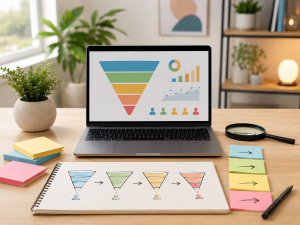
At the big-picture level, funnels are about guidance.
They help people move from curiosity to clarity.
Instead of hoping visitors figure things out alone, you give them a path.
That path should feel helpful, simple, and logical.
First, someone discovers you through content.
Then they receive something useful.
Next, they hear from you again.
Over time, they understand how you can help.
Eventually, they may take the next step.
This process is not about tricking people.
A good funnel should never feel sneaky.
Instead, it should feel like a helpful guide saying, “Here’s the next step when you’re ready.”
That is why beginner funnels should focus on value.
When you help first, the rest becomes easier.
Also, remember that no funnel is perfect at first.
Your first version may be clunky.
That is okay.
Every marketer has built something that later made them cringe a little.
The important thing is to launch, learn, and improve.
Funnels are not statues.
They are living systems.
You can update them as you grow.
Final Thoughts on Sales Funnels for Beginners
Sales funnels for beginners do not need to be complicated, expensive, or stressful.
They just need to be clear.
A strong funnel helps people discover your content, receive value, build trust, and take a logical next step.
That can happen through a lead magnet funnel, content funnel, webinar funnel, free course funnel, tripwire funnel, case study funnel, challenge funnel, or email follow-up funnel.
Each model has its own strengths.
However, they all work best when they are simple and focused.
Start with one audience.
Solve one problem.
Offer one helpful resource.
Create one follow-up path.
Then send traffic to it consistently.
As your skills improve, you can add more pieces.
Until then, keep things lean.
A simple funnel that works is much better than a complicated funnel that sits unfinished in your digital junk drawer.
So, choose one funnel idea from this post and build the first version.
It does not have to be perfect.
It just has to exist.
After all, the best funnel is not the one you keep planning forever.
It is the one that helps real people take the next helpful step.
