

How to Improve Your Content With 12 Fixes Most Skip
Do This Overnight With Small Tweaks

How to Improve Your Content: Introduction
If you have ever stared at a post, email, caption, or blog draft and thought, well, this is technically content, but it also has the energy of dry toast, you are not alone. Learning how to improve your content does not require a dramatic rebrand, a ten-ring binder full of strategy notes, or a candlelit retreat in the mountains with your laptop. In reality, the biggest improvements usually come from simple fixes applied consistently. Search guidance also leans toward helpful, people-first content that uses the words your audience actually searches for in important places like titles and headings, which means clarity wins twice: for readers and for SEO.
That is good news, especially if you are still figuring things out. In fact, some of the best content creation tips for beginners are not flashy at all. They are practical, repeatable, and surprisingly effective. A stronger hook, cleaner wording, better examples, more breathing room, and a simple next step can turn a forgettable piece into something readers actually finish. Meanwhile, a few smart content optimization tips can help that same piece stay useful longer instead of vanishing into the internet void five minutes after you publish it.
So, let’s make this easy. Below, you will learn how to improve your content with twelve core upgrades, plus extra strategies to make everything clearer, more engaging, and a lot more polished. Think of it as a content makeover, minus the reality show judges and unnecessary dramatic music.
Why How to Improve Your Content Starts With One Clear Goal
Before you fix wording, visuals, or structure, figure out what the piece is supposed to do. This sounds obvious, yet it is where many drafts go off the rails. One paragraph tries to inspire. The next tries to teach. Then suddenly there is a mini rant, a motivational quote, and a random call to action tacked on like a loose trailer hitch. As a result, the reader has no idea what they are meant to take away.
Instead, decide on one goal for each piece of content. Maybe you want to teach one practical skill. Maybe you want the reader to rethink one mistake. Perhaps you want them to save the post for later. Whatever it is, choose one main outcome and build around it. When you know the destination, everything becomes easier. Your hook gets sharper. Your examples fit better. Your ending feels natural.
For example, if you are writing a post about beginner content mistakes, do not also cram in branding, mindset, networking, and your grocery list. Focus on one promise. A focused draft feels more confident, and confident content is much more pleasant to read.
How to Improve Your Content by Fixing the First Line
Your opening line is doing far more work than you think. It is not just the first sentence. It is the bouncer at the club. If that line is weak, vague, or sleepy, your reader is not getting past the velvet rope. On the other hand, when the hook sparks curiosity or calls out a familiar struggle, people lean in.
A lazy first line says, here are some tips on content. A better first line says, most beginners ruin good content before the second sentence. Same topic, very different energy. Suddenly there is tension. The reader wants to know what the mistake is and whether they are doing it. Curiosity is powerful, and thankfully, you do not need to sound like a movie trailer to create it.
When thinking about how to improve your content, start by writing five to ten opening lines before choosing one. Yes, five to ten. No, this is not punishment. It is editing. Try a bold statement, a surprising mistake, a relatable frustration, or a question that makes the reader mentally answer back. Your first line should feel like a door opening, not a waiting room form.
If you want more swipeable ideas for better openings, these scroll stopping hooks for engagement are a handy next step before you rewrite your next intro.
Improve Your Content With Cleaner, Shorter Sentences
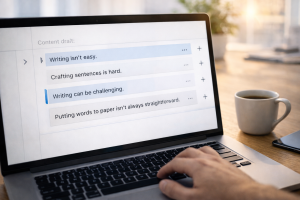
One of the most useful content writing tips for beginners is this: shorter sentences are not less intelligent. They are more readable. Beginners often write as if every sentence must prove they have access to large words and several commas. However, clearer writing nearly always performs better than complicated writing that makes readers squint.
Here is the easiest test. Read your draft out loud. If you run out of breath halfway through a sentence, your reader probably ran out of patience halfway through the paragraph. Break long thoughts into smaller pieces. Remove filler. Cut phrases like in order to, due to the fact that, and it is important to note that unless they are truly needed. Usually they are not. They are just hanging around like uninvited party guests.
For instance, instead of writing, you should really consider implementing this strategy because it may potentially help improve your results over time, try this: use this strategy to get better results faster. Same point. Less fog. Better rhythm. Clean writing makes content feel more confident, and confidence is wildly attractive in a blog post.
Improve Your Content Using Audience Language
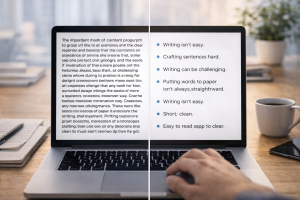
If your audience says, I feel stuck, do not write, you are experiencing implementation paralysis due to strategic uncertainty. Technically, that is language. Practically, it is not helping anybody. One of the easiest ways to improve clarity is to borrow the exact phrases your audience already uses.
Look at comments, emails, direct messages, forum questions, and even your own notes from past conversations. Notice the repeated words. Beginners often use emotional language such as overwhelmed, confused, inconsistent, and not sure where to start. Those are valuable clues.
When your content reflects the reader’s real vocabulary, it feels instantly more relevant.
This is also one of the better content optimization tips for SEO. Search guidance recommends using the words people actually use to look for your content in important places like titles and headings. That does not mean stuffing keywords everywhere like you are salting fries. It means writing in the language your readers already understand.
So, if your audience searches for how to improve your content, use that phrase naturally. Then support it with related language such as content creation tips for beginners and content writing tips for beginners where they genuinely fit. Helpful and human beats robotic every time.
Improve Your Content With One Main Point Per Section
Another reason content feels messy is that sections wander. A paragraph starts with one idea, then wanders into a side story, picks up a motivational quote, and somehow ends in a sales-ish line about success. That is not a section. That is a road trip with no map.
To fix this, give every section one clear job. If a section is about hooks, keep it about hooks. If it is about white space, do not drift into email subject lines and weekend productivity routines.
Readers like momentum. When each section delivers one clean takeaway, the whole piece feels easier to follow.
A handy trick is to summarize each section in a single sentence before you write it. For example: this section teaches why examples make ideas clearer. That one sentence becomes your guardrail. Anytime you start drifting, come back to it. Suddenly the section tightens up, and your blog starts acting like a blog instead of a group chat that lost focus three screens ago.
Improve Your Content by Adding Examples That Actually Help
Advice without examples is like handing someone furniture instructions with half the pages missing. The point may be there, but good luck assembling anything. Readers understand faster when you show the advice in action.
Let’s say you tell people to write stronger hooks. Helpful, sure. But what does stronger mean? That word is too vague on its own. Now add an example: instead of saying, here are some content tips, say, most beginners make this content mistake without realizing it. Suddenly the lesson clicks. The reader can see the difference instead of guessing.
Examples also make your post feel more practical and less preachy. That matters because nobody enjoys being lectured by a paragraph wearing a tie. If possible, use a mix of real examples, before-and-after examples, and small hypothetical scenarios. Even one sentence can do the trick. The goal is not to impress people with complexity. It is to remove friction. Great examples do exactly that.

Improve Your Content With Better Visual Flow
Even if your content is strong, bad presentation can make it feel harder than it really is. This is especially true for blogs, captions, carousels, and emails. A reader who sees giant blocks of text may leave before discovering that your advice is excellent. It is unfair, yes. It is also real.
Visual flow simply means guiding the eye in a natural way. Headings should clearly signal what comes next. Important lines should stand out. Paragraphs should not feel like climbing a staircase made of wet cement. The cleaner the path, the easier it is for readers to keep moving.
This is one reason readable, descriptive titles matter too. And if your title still feels a little sleepy, these headline formulas that grab attention can help you sharpen the promise before anyone reads the first paragraph.
Google has said it aims to generate readable and accessible titles in search, and when titles are too long, it may select the most useful portion instead. In other words, clarity is not just nice for readers on your page. It matters before the click as well.
Improve Your Content With White Space and Breathing Room
White space is not wasted space. It is what keeps your content from feeling like an elevator with twelve people, three backpacks, and somebody’s emotional support ferret. Readers need room to breathe. If you want a deeper walkthrough on the design side, this guide on how to make your content look professional breaks down the small visual tweaks that instantly make posts feel more polished.
In blog writing, that means shorter paragraphs, clear subheadings, and enough separation between ideas. In social content, it means avoiding slides packed with tiny text that require the eyesight of a hawk and the patience of a saint. White space reduces overwhelm, especially for beginners who are already processing new information.
Meanwhile, it gives your strongest lines more power. A useful sentence buried in a dense paragraph gets missed. The same sentence surrounded by breathing room feels more important. So, when in doubt, spread things out a little. Your content will look calmer, clearer, and more intentional almost immediately.

Improve Your Content With Consistent Branding
Consistency makes content feel professional, even when the design itself is simple. If every post uses different colors, fonts, tones, and layouts, the overall impression becomes scattered. The audience may not know exactly why it feels off, but they will feel it.
Choose a small, repeatable visual system. Two or three colors are enough. One or two fonts are enough. A familiar structure is enough. You do not need a brand guide thick enough to stop a door. You just need consistency. Over time, that consistency builds recognition and trust.
The same goes for your writing voice. If one post sounds like a helpful friend and the next sounds like a very serious robot with a clipboard, the shift is jarring. A casual, clear, reliable tone is easier to connect with. That matters because polished, consistent content also helps you learn how to build credibility online fast, especially when readers are seeing your work for the first time.
Even the phrase Internet Profit Success, for example, sounds more believable when the surrounding content feels grounded, practical, and human rather than overhyped. Fancy wording cannot rescue inconsistent messaging. Steady voice can.
Improve Your Content by Turning Walls of Text Into Scannable Sections
Readers do not always move through a piece word by word from start to finish. Often, they scan first. They look for headings, patterns, and quick clues that tell them whether the content is worth their time. That is not laziness. It is survival. The internet trained all of us to make snap decisions somewhere around our seventeenth open tab.
That is why scan ability matters so much. Break long ideas into smaller sections. Use descriptive headings. Keep paragraphs focused. Make sure someone can skim the article and still understand the main takeaways. Then, once they realize the content is useful, they are far more likely to slow down and read properly.
This is especially important when you are teaching. A long-form post can absolutely rank and perform well, but only if it feels easy to navigate. Helpful content should not feel like a maze. It should feel like a guided tour where the guide knows where the bathrooms are and does not make anyone read a wall of text carved into stone.
Improve Your Content With Smarter Calls to Action
Many beginner posts end with a thud. The advice is useful, the section works, and then the final line basically says, okay bye. That is a missed opportunity. A good call to action gives the reader one simple next move.
The key word is simple. You are not asking them to join a secret society, memorize a funnel, and launch a six-part strategy by dinner. You are asking for one reasonable action. Save this idea. Try one tip today. Rewrite your next opening line. Review your last post for fluff. Small actions create momentum.
Better calls to action also match the stage of the reader. If the post is full of content creation tips for beginners, the CTA should feel beginner-friendly too. Ask for something doable. Otherwise, the reader leaves feeling inspired but slightly panicked, which is not the emotional tone most of us are going for before lunch.
Improve Your Content by Telling Tiny Stories
Stories make content memorable because they turn abstract advice into something human. Thankfully, you do not need to write a dramatic saga involving storms, destiny, and a notebook found in an attic. Tiny stories work beautifully.
For example, say you learned the value of stronger hooks after one of your posts flopped harder than a pancake dropped from a balcony. That moment is relatable. Tell it briefly. Explain what you changed. Then connect the lesson to the reader. Suddenly the advice feels lived-in rather than copied from a checklist.
Stories also create trust. They show that you are not speaking from a floating cloud of perfection. You are someone who tested things, made mistakes, and learned what helped. That kind of honesty is useful. It lowers resistance and makes the content feel warmer. If you want to get better at weaving those moments into your message, this storytelling in marketing guide is a smart follow-on read. Meanwhile, it gives the reader something to remember besides a list of rules.
Improve Your Content Through Repurposing
You do not need a completely new idea every day. In fact, forcing newness constantly is one of the fastest ways to produce tired content with the emotional depth of a parking receipt.
Repurposing is smarter.
Take one strong idea and turn it into multiple formats. A blog section can become a short post. A carousel can become an email. A mini story can become a reel script. The same principle carries into inbox content too, so these email subject line templates can help when you repurpose your blog ideas into email. A list of mistakes can become a before-and-after post.
The core idea stays the same, but the delivery changes. That saves time and gives your best ideas more chances to be seen.
Repurposing also helps you notice what resonates. For a deeper breakdown, this content repurposing for SEO guide shows how to turn one strong idea into multiple assets without reinventing the wheel. Maybe readers respond strongly to examples but not abstract theory.
Maybe they love quick fixes more than big frameworks. That information helps you improve future content. So, instead of endlessly creating from scratch, start treating your best content like leftovers from a very good dinner. Still useful. Still delicious. Possibly even better the next day.

Improve Your Content With a Beginner-Friendly Workflow
A lot of content problems are not really writing problems. They are process problems. If you sit down with no outline, no angle, no examples, and no idea what the ending should do, the draft will likely wobble. That is normal. It is also fixable.
Try this simple workflow. First, choose one goal. Second, write your headline or main promise. Third, sketch three to five supporting points. Fourth, add one example or mini story to each point. Fifth, tighten the wording. Finally, add a clear ending with one next step. That is it. Nothing fancy. No ceremonial gong required.
This process works because it lowers chaos. It also supports SEO naturally. Search-friendly writing is easier when the structure is clear, the topic is focused, and the headings reflect real questions readers care about. Google’s guidance consistently points toward helpful, reliable, people-first content rather than pages built only to chase rankings.
Content Creation Tips for Beginners That Save Time
If you are new to this, efficiency matters because overcomplicating the process is a great way to avoid publishing anything at all. One of the best content creation tips for beginners is to build a swipe file of strong hooks, useful examples, and common audience questions. That way, you are not inventing every draft from thin air.
Another helpful move is to keep a running idea list. Whenever you notice a repeated question, a mistake you keep seeing, or a lesson you learned the hard way, write it down. These notes become future posts. Suddenly content feels less like a daily emergency and more like a system.
Also, draft faster than you edit. Those are different jobs. Writing and editing at the same time is like driving with one foot on the gas and one on the brake. You make noise, but you do not get very far. Let the first draft be messy. Then clean it up with intention. Much better for the content. Much better for your blood pressure.
Content Writing Tips for Beginners Who Want More Clarity
Among all content writing tips for beginners, clarity is the one worth obsessing over. Not perfection. Not cleverness. Not sounding impressive enough to intimidate a Victorian librarian. Clarity.
To get there, ask yourself a few simple questions while editing. Can the reader understand this on the first pass? Is the point obvious without extra explanation? Did I use a real example? Did I repeat myself because I was thinking out loud on the page? Those questions catch a surprising number of problems.
It also helps to vary sentence length and openings. Transitional phrases such as however, for example, meanwhile, in addition, on the other hand, and as a result can improve flow when used naturally. They guide the reader without sounding mechanical. Think of transitions as little bridges. They keep the reader moving from one idea to the next without falling into the river below.
Content Optimization Tips That Keep Posts Working Longer
Once a post is written, optimization helps it do more with the effort you already spent. Start with the basics. Make sure the topic is clear. Use a descriptive title. Include your main keyword naturally in the heading, introduction, and a few relevant subheadings. Add related phrases where they genuinely support the topic. That is smart optimization. Keyword stuffing, meanwhile, is just content wearing too much cologne.
Descriptive titles and informative meta descriptions remain useful because they help summarize what a page is about. Google has long recommended unique, descriptive titles, and informative meta descriptions can influence the snippet shown in search results, which may affect whether people click.
Beyond that, revisit older posts. Tighten weak intros. Add fresher examples. Improve headings. Clarify the CTA. Repurpose strong sections into new formats. Often, the fastest way to get better results is not producing more content. It is improving the content you already have. And if you want these improvements to keep working for months instead of days, these evergreen content types are worth building into your content plan.
Improve Your Content and Keep It Human for SEO
There is a strange fear some writers have that SEO and humanity cannot sit at the same table. One side imagines robotic keyword stuffing. The other side imagines artful prose that refuses to mention what the article is actually about. In reality, the strongest approach combines both. Use the language people search for, but write for humans first.
That means your main keyword, how to improve your content, should appear naturally where it makes sense. It belongs in the title, introduction, and selected headings because it accurately describes the topic. Related phrases like content creation tips for beginners, content writing tips for beginners, and content optimization tips support the theme without sounding repetitive.
Search guidance also stresses helpful content, descriptive titles, and language people actually use, which fits this approach nicely.
At the same time, resist the urge to turn your article into a keyword parade wearing matching hats. Readers notice that. They may not know the term keyword stuffing, but they know when writing sounds weird. Natural language wins. Always.
Improve Your Content Over Time Instead of Chasing Perfection
One of the biggest traps in content creation is waiting until everything feels flawless. Sadly, flawless is a fictional creature, usually spotted near unicorns and inbox zero. Improvement is the real goal.
Treat each piece as a chance to get better at one or two things. Maybe this week you focus on stronger openings. Next week, better examples. Then shorter paragraphs. Then cleaner calls to action. Over time, these small improvements stack up. What felt hard becomes normal. What felt slow becomes faster.
This is why quick wins matter so much. They create momentum. And momentum matters because consistent, useful content compounds. The more you publish, review, refine, and repurpose, the more your voice sharpens and your structure improves. Eventually, you stop guessing quite so much. You still edit, of course, but the work feels lighter. Less chaos. More rhythm. Fewer paragraphs that sound like they were written by a stressed raccoon at midnight.
Final Thoughts on How to Improve Your Content
If you remember only one thing from this article, let it be this: learning how to improve your content is usually less about doing more and more about doing the basics better. Stronger first lines. Cleaner sentences. Better examples. More white space. Clearer sections. Smarter calls to action. A consistent voice. Those are not glamorous fixes, but they work.
Just as importantly, they work for beginners. You do not need a giant strategy deck or a mysterious algorithm whisperer hiding in your basement. You need a clear message, a helpful structure, and the willingness to revise the pieces that are not pulling their weight. Start small. Improve one thing today. Then another tomorrow.
Soon enough, your content will feel more polished, more readable, and much more useful to the people you want to reach. And that, ultimately, is the whole game. Helpful content earns attention. Clear content keeps it. Human content builds trust. Everything else is just decorative parsley.
