

Email Nurture Sequence: 6 Steps That Convert
Turns Leads Into Buyers

WHY YOUR EMAIL NURTURE SEQUENCE MATTERS MORE THAN YOU THINK
Collecting email addresses feels exciting. Watching your subscriber count tick up gives you that little rush of validation. However, here’s the truth: a list without an email nurture sequence is like owning a car with no engine. It looks good on the outside, but it is not taking you anywhere.
In other words, the real magic happens after someone joins your list.
An email nurture sequence is what transforms cold subscribers into warm readers, engaged followers, and eventually paying customers. Without it, you are basically leaving results to chance. Meanwhile, businesses that build a structured email nurture sequence create consistent engagement, predictable conversions, and long-term relationships.
If you are serious about building trust, authority, and long-term Internet Profit Success, then mastering your email nurture sequence is not optional. It is foundational.
In this guide, we are going deep. You will learn how to create an email nurture sequence from scratch, see email nurture sequence examples, understand email automation for beginners, and walk away with a step-by-step system you can implement immediately.
Before you even think about nurturing, make sure you have a solid foundation in how to grow an email list, that’s what makes everything else work, like unlocking email list building for beginners.
Let’s dive in.
WHAT IS AN EMAIL NURTURE SEQUENCE AND WHY DOES IT WORK?
Before we build one, we need to understand it.
An email nurture sequence is a pre-planned series of emails automatically sent to new subscribers over a set period of time. Instead of blasting random messages whenever you remember, the sequence delivers carefully structured content designed to guide readers from curiosity to trust to action.
Now, why does this work so well?
First, consistency builds familiarity. People trust what they see repeatedly. Second, structured value builds authority. When subscribers learn something helpful from you, they begin to associate you with solutions. Finally, progression builds momentum. Each email builds on the last, creating a natural path toward your offer.
For example, imagine joining a list and immediately receiving five aggressive sales emails. You would probably unsubscribe. On the other hand, if you received helpful tips, relatable stories, and useful advice before any pitch appeared, you would likely stay engaged.
When your content helps consistently, like the guide on Evergreen content types that build trust & last for SEO subscribers begin to see real value.
That is the power of a well-crafted email nurture sequence.
DEFINE YOUR GOAL BEFORE BUILDING YOUR EMAIL NURTURE SEQUENCE
Before writing a single word, clarity must come first.
Every effective email nurture sequence begins with a clear objective. Otherwise, you risk sending mixed messages.
Are you trying to build trust? Educate beginners? Onboard new customers? Introduce a flagship product? Each goal requires a slightly different structure.
For example, if your goal is education, then most of your early emails should focus on tutorials and guidance. However, if your goal is onboarding, your sequence may emphasize usage tips and support resources.
In addition, define your audience segment carefully. A beginner-focused email nurture sequence should avoid jargon and advanced strategies. Meanwhile, experienced subscribers may prefer deeper insights.
Write down your goal in one sentence. Then, describe your target reader in one paragraph. This clarity will shape everything else.
1. HOW TO CREATE AN EMAIL SEQUENCE THAT FLOWS NATURALLY
Now we get tactical.
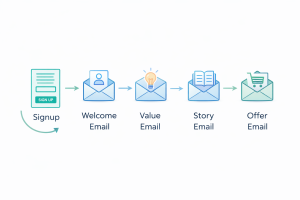
Learning how to create an email sequence is less about writing and more about mapping the journey. Think of your sequence like a mini story arc.
Start with a welcome email. This first message sets expectations and delivers any promised lead magnet. It should also introduce your voice and personality.
Next, follow with one or two value-driven emails. For example, you might share a beginner mistake, a helpful checklist, or a quick tutorial. The key here is giving before asking.
After that, introduce a story-based email. Share a personal experience, a case study, or a before-and-after scenario. Stories create emotional connection, which dramatically increases engagement.
Then, transition into a soft pitch. Introduce your solution gently. Explain how it connects to the problems you have been discussing.
Finally, close with a stronger invitation. By this point, readers should feel informed and comfortable.
This logical progression keeps subscribers engaged rather than overwhelmed.

2. EMAIL NURTURE SEQUENCE EXAMPLES YOU CAN MODEL
Seeing examples makes everything clearer.
Here is a simple five-email structure many beginners use successfully:
Email 1: Welcome and deliver the free resource. Set expectations for upcoming emails.
Email 2: Teach a simple, actionable strategy related to your niche.
Email 3: Share a story or case study showing results from implementing that strategy.
Email 4: Provide deeper value. This might include a checklist, framework, or advanced tip.
Email 5: Introduce your core offer and explain how it accelerates results.
Notice the pattern. Value first. Trust second. Offer third.
Equally important to what you include is how you title each message, check out headline formulas that grab attention & boost clicks for subject line ideas that get opens.
Meanwhile, more advanced email nurture sequence examples might include behavioral triggers. For instance, if someone clicks a link but does not purchase, they receive a follow-up email addressing objections. On the other hand, if they purchase, they enter a different onboarding sequence.
However, beginners should keep things simple initially. Complexity can come later.
3. PROVIDE VALUE FIRST: THE GOLDEN RULE OF EVERY EMAIL NURTURE SEQUENCE
Although it is tempting to sell quickly, patience pays off.
The first half of your email nurture sequence should focus primarily on helping. Teach something useful. Solve a small problem. Share an insight that feels practical.
For example, if your niche is email marketing, you might explain how subject lines influence open rates. Alternatively, you could provide a template readers can adapt immediately.
When subscribers consistently gain value from your emails, they open future messages eagerly. Meanwhile, if early emails feel pushy, engagement drops fast.
Therefore, aim to create at least two or three emails that contain zero pitching. Build goodwill first. Then introduce your offer naturally.

4. USE STORYTELLING TO SUPERCHARGE YOUR EMAIL NURTURE SEQUENCE
Facts inform. Stories persuade.
Within your email nurture sequence, include at least one compelling story. It could be your personal journey, a client transformation, or a relatable struggle.
For instance, you might describe how you once struggled with low engagement until you restructured your sequence. Explain what changed. Highlight the turning point. Show the outcome.
Readers see themselves in stories. As a result, they imagine achieving similar success.
In addition, storytelling makes your content memorable. Technical advice is often forgotten. Emotional narratives stick.
Meanwhile, keep stories concise and purposeful. Every story should support the overall goal of the sequence.

5. CLEAR CALLS TO ACTION IN EVERY EMAIL NURTURE SEQUENCE
Even the best content fails without direction.
Each email in your email nurture sequence should include one clear next step. That step could be reading an article, replying with a question, downloading a checklist, or exploring your offer.
Avoid multiple competing calls to action. Confusion reduces action.
For example, instead of saying, “Check out my course, read my blog, follow me on social media, and reply to this email,” choose one primary action.
Crafting enticing calls to action makes your nurture sequence convert better, for examples and templates, check out CTA templates that boost click-throughs.
Clarity equals momentum.
6. EMAIL AUTOMATION FOR BEGINNERS: SET IT UP THE RIGHT WAY
Fortunately, modern tools make email automation for beginners extremely accessible.
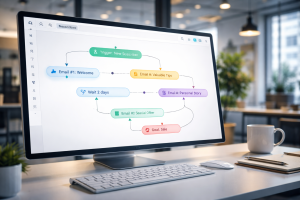
Most platforms allow you to create automated sequences triggered by sign-ups. Once set up, the sequence runs on autopilot.
However, automation does not mean ignoring performance. Instead, monitor open rates, click-through rates, and replies regularly.
In addition, test subject lines. Small tweaks often produce noticeable improvements. For example, curiosity-based subject lines typically outperform generic ones.
Meanwhile, avoid overcomplicating your automation in the beginning. Start with a simple linear sequence. As your confidence grows, experiment with segmentation and behavioral triggers.
TEST AND OPTIMIZE YOUR EMAIL NURTURE SEQUENCE OVER TIME
Your first draft is not your final draft.
Track key metrics such as open rate, click rate, and conversion rate. If Email 3 consistently underperforms, revise its subject line or content.
Likewise, experiment with send timing. Some audiences respond better in the morning. Others engage more in the evening.
Optimization is ongoing. Over time, incremental improvements compound significantly.
Understanding which parts of your sequence are performing matters, see Marketing Metrics for Beginners: 7 You Must Track Today for the key measurements you should monitor.

AVOID THESE COMMON EMAIL NURTURE SEQUENCE MISTAKES
Even well-intentioned creators make errors.
One common mistake is overwhelming subscribers with too much information. Keep emails focused. Another mistake is inconsistent tone. Your personality should remain consistent throughout the sequence.
Additionally, avoid overly long paragraphs. Readers scan emails quickly. Shorter sections improve readability.
Finally, do not forget to set expectations in your welcome email. Let subscribers know how often you will email them.
ADVANCED STRATEGIES TO ELEVATE YOUR EMAIL NURTURE SEQUENCE
Once your foundation is solid, consider adding advanced elements.
For example, segmentation allows you to send different follow-up emails based on interests. If someone clicks on a topic about automation, you can send deeper automation content later.
Likewise, behavioral triggers increase relevance. When emails feel personalized, engagement rises.
Furthermore, integrating occasional surveys within your email nurture sequence helps you understand your audience better. Feedback fuels improvement.
Meanwhile, ensure that any advanced strategy still aligns with your main goal.
HOW AN EMAIL NURTURE SEQUENCE SUPPORTS LONG-TERM INTERNET PROFIT SUCCESS
Consistency builds businesses.
An effective email nurture sequence generates predictable engagement. Over time, that engagement translates into steady revenue.
Unlike social media posts that disappear in crowded feeds, email creates a direct line to your audience. Therefore, nurturing subscribers properly compounds results month after month.
When executed strategically, your email nurture sequence becomes an asset. It works behind the scenes, building relationships while you focus on other areas of your business.
That is the foundation of sustainable Internet Profit Success.

CONCLUSION: BUILD YOUR EMAIL NURTURE SEQUENCE TODAY
To recap, an email nurture sequence is more than a set of emails. It is a relationship-building system.
By defining your goal, mapping a logical flow, delivering value first, incorporating stories, using clear calls to action, automating wisely, and optimizing consistently, you create a powerful engine for growth.
Start simple. Stay consistent. Improve gradually.
Above all, remember that subscribers are people. Treat them with respect, provide genuine value, and guide them clearly.
Do that, and your email nurture sequence will not just convert leads. It will build trust, authority, and long-term success.
