

11 Content Repurposing Strategies
That Multiply Your Reach
Turn one good idea into social posts, videos, emails, lead magnets and more—without starting from scratch every day.

INTRODUCTION: WORK SMARTER WITH CONTENT REPURPOSING STRATEGIES
Content creation can feel like feeding a very hungry monster.
You publish a blog post.
Then you need a Facebook post.
Next comes LinkedIn.
After that, you need an email.
Before long, you are staring at the screen wondering where all your ideas went.
That is why content repurposing strategies are so useful.
Instead of creating everything from scratch, you start with one strong idea. Then you reshape that idea for different places and different people.
For example, one useful blog article might become:
* Five Facebook posts
* Three LinkedIn posts
* Four short videos
* One email newsletter
* One checklist
* One carousel
* One live training session
Suddenly, one idea has become weeks of marketing.
That does not mean copying and pasting the same thing everywhere.
Instead, good content repurposing means adapting the message to suit each platform.
A Facebook reader behaves differently from an email subscriber.
Meanwhile, someone watching a short video may want a much quicker answer.
The core lesson stays the same.
Whatever format you choose, learning how to create engaging content will help you keep the message useful, clear, and interesting instead of simply recycling words.
The delivery changes.
That simple shift can save hours of work.
If finding enough time is still a struggle, these content creation tips for entrepreneurs short on time can help you simplify the rest of your content routine.
More importantly, it helps you stay visible without feeling chained to your keyboard.
Simple Content Repurposing Diagram
ONE USEFUL IDEA
↓
BLOG ARTICLE
↓
SOCIAL POSTS
↓
VIDEOS
↓
EMAILS
↓
CHECKLISTS
↓
LIVE TRAINING
↓
MORE PEOPLE SEE YOUR MESSAGE
KEY TAKEAWAY:
Create once. Adapt often. Keep the useful message working for longer.
Short Summary:
Content repurposing strategies help you get more value from ideas you have already created.
WHY CONTENT REPURPOSING STRATEGIES MATTER
Beginners often think successful marketers have a magical cupboard full of endless content ideas.
Usually, they do not.
They simply become good at using each idea more than once.
Imagine you spend three hours researching and writing a useful article.
If you publish it once and forget about it, those three hours produce one marketing asset.
However, what if that same article creates 15 additional pieces of content?
Now those three hours become much more valuable.
Content repurposing strategies can also help you:
* Stay consistent
* Reach different audiences
* Save research time
* Strengthen your main message
* Improve brand recognition
* Feed several marketing channels
* Get more value from successful content
There is another benefit.
People rarely remember something after seeing it once.
You might explain an idea in a blog post today.
Next week, someone sees the same lesson in a Facebook post.
Later, they receive an email explaining it from another angle.
Eventually, the message begins to stick.
That is not boring repetition.
It is reinforcement.
For beginner marketers, this can make content marketing much easier to manage.
If you are still building the foundations, these content marketing strategies for beginners can help you decide what to create and why you are creating it.
KEY TAKEAWAY:
You do not always need another idea. Sometimes you need another way to use the idea you already have.
Short Summary:
Repurposing increases the return you get from the time spent creating useful content.
CONTENT REPURPOSING STRATEGY #1:
TURN A BLOG POST INTO SOCIAL MEDIA POSTS
A detailed blog article usually contains several smaller ideas.
Each of those ideas can become its own social media post.
Suppose you write an article called:
8 Lead Generation Strategies That Still Work Today
That article might produce posts about:
* Creating a lead magnet
* Improving landing pages
* Building an email list
* Using social media
* Following up with prospects
* Asking better questions
* Testing calls to action
* Measuring lead quality
You have now turned one article into eight pieces of social content.
If Facebook is one of your main channels, these Facebook marketing tips for beginners can help you turn those repurposed ideas into posts that encourage more conversations and engagement.
However, do not simply copy paragraphs from the article.
Shorten the idea.
Give it a strong opening.
Add one clear lesson.
Then finish with a simple question or action.
For example:
Original blog idea:
A useful lead magnet should solve one small problem quickly.
Social version:
Your free gift does not need to contain everything you know.
It needs to solve one useful problem.
A simple checklist that gets used can beat a 70-page ebook nobody reads.
That feels natural on social media.
Action Step:
* Open one recent article.
* Highlight five useful points.
* Turn each point into one short post.
* Change the opening sentence for each platform.
* Schedule them across several days.
KEY TAKEAWAY:
Your blog post is not one piece of content.
It is a container full of smaller content ideas.
Short Summary:
One well-written article can provide days or even weeks of social media material.

CONTENT REPURPOSING STRATEGY #2:
REPURPOSE CONTENT FOR SOCIAL MEDIA VIDEO
Video gives your existing ideas another life.
Fortunately, you do not need a film studio.
You do not need dramatic lighting.
You definitely do not need someone shouting, “Action!”
A phone, a useful idea, and decent sound can be enough.
Start with one section from an existing article.
Next, explain that point in 30 to 90 seconds.
For example, an email marketing article might contain five mistakes.
Each mistake could become one short video.
Your series might look like this:
Video 1: Why people ignore your emails
Video 2: Why weak subject lines hurt
Video 3: Why every email needs a purpose
Video 4: Why too many sales pitches lose trust
Video 5: Why follow-up matters
The research has already been done.
You are simply changing the format.
A simple video structure helps.
HOOK
↓
ONE PROBLEM
↓
ONE USEFUL TIP
↓
ONE EXAMPLE
↓
ONE NEXT STEP
Meanwhile, avoid squeezing an entire article into a one-minute video.
Choose one lesson instead.
That makes the video clearer.
Action Step:
* Choose one article.
* Pick three sections.
* Write one sentence explaining each section.
* Record three short videos.
* Keep each video focused on one problem.
KEY TAKEAWAY:
Short videos work best when they teach one clear idea rather than everything at once.
Short Summary:
Learning how to repurpose content into video lets you reach people who prefer watching instead of reading.
CONTENT REPURPOSING STRATEGY #3:
TURN VIDEOS INTO BLOG ARTICLES
Content repurposing works both ways.
A written article can become a video.
Likewise, a video can become an article.
Perhaps you have recorded a Facebook Live, tutorial, webinar, or short training.
That recording contains valuable material.
Start by creating a transcript.
Next, clean it up.
Spoken language usually needs editing before it becomes good written content.
People say things like:
"Erm.”
“You know.”
“Basically.”
“And, er, anyway.”
Those are perfectly normal when speaking.
However, your reader does not need to enjoy every one of them.
After editing the transcript, add:
* A clear introduction
* Helpful headings
* Short paragraphs
* Examples
* Bullet points
* Action steps
* A conclusion
You can also expand points that were rushed in the video.
For example, a 15-minute training about affiliate marketing could become a detailed beginner guide.
The video provides the raw material.
The article provides the polished version.
Action Step:
Choose one useful video you have already created.
Then:
* Transcribe it.
* Remove repeated words.
* Divide it into sections.
* Add examples.
* Add an introduction and conclusion.
* Publish the improved written version.
KEY TAKEAWAY:
Your spoken ideas are valuable content assets too.
Short Summary:
Videos can become articles, newsletters, guides, and other useful written resources.
CONTENT REPURPOSING STRATEGY #4:
TURN EXISTING CONTENT INTO EMAILS
Your email subscribers probably do not see everything you publish.
That is good news.
It means useful material from your blog or social channels can become email content.
Suppose you recently published a detailed post about building trust.
Instead of emailing the entire article, choose one lesson.
You might write about one mistake.
Perhaps you explain a short personal experience.
Then you connect that story with the lesson.
A simple email structure could be:
PROBLEM
↓
SHORT STORY
↓
LESSON
↓
USEFUL TIP
↓
NEXT STEP
For example:
Maybe you once believed sending more promotional emails automatically meant making more sales.
However, your subscribers stopped responding.
That experience could become an email about balancing helpful content with product recommendations.
Now you are not simply recycling words.
You are adapting the idea.
You can also turn one long article into an email series.
For example:
Day 1: Introduce the problem
Day 2: Explain mistake one
Day 3: Share an example
Day 4: Explain another solution
Day 5: Recommend the next step
That gives the original content far more value.
Action Step:
Take one strong section from your latest blog article.
Rewrite it as a short email with one lesson and one action.
KEY TAKEAWAY:
Your subscribers do not need brand-new ideas every day. They need useful ideas delivered clearly.
Short Summary:
Existing articles and social posts can become newsletters and email sequences with very little extra research.

CONTENT REPURPOSING STRATEGY #5
TURN CONTENT INTO A CHECKLIST
People like information.
However, they often love instructions even more.
That is why checklists are powerful content repurposing ideas.
A checklist converts knowledge into action.
For example, imagine you wrote an article about publishing a blog post.
Your checklist might include:
* Choose the main keyword
* Write the headline
* Create an introduction
* Add useful headings
* Include examples
* Add images
* Check spelling
* Add internal links
* Write the meta description
* Add a call to action
* Publish
* Promote the article
Suddenly, your article has become a practical tool.
Checklists can also make excellent lead magnets.
If you want to go beyond checklists, these lead magnet ideas show several other ways to turn useful knowledge into resources people will exchange their email address to receive.
Why?
Because they provide a quick win.
Readers do not need another enormous ebook collecting digital dust somewhere on their computer.
They often need something simple they can use today.
When creating a checklist:
* Keep each step short.
* Use a logical order.
* Remove unnecessary explanation.
* Make the task feel achievable.
* Focus on one result.
For example, “Website Marketing Checklist” is too broad.
On the other hand, “10 Things to Check Before Publishing a Blog Post” is much clearer.
Action Step:
Find one article that teaches a process.
Turn every important action into one checklist item.
KEY TAKEAWAY:
Educational content tells people what to do. A checklist helps them actually do it.
Short Summary:
Checklists turn detailed information into simple action and can also become useful lead magnets.
Once that resource begins attracting subscribers, these lead generation strategies can help you connect your content, email list, and calls to action into a clearer customer journey.
CONTENT REPURPOSING STRATEGY #6
CREATE CAROUSEL POSTS
Carousel posts are useful because they turn larger ideas into small steps.
Instead of asking someone to read a long article, you guide them through the lesson one screen at a time.
A list article is perfect for this.
For example:
7 Ways to Improve Your Email Marketing
could become:
Slide 1: The main promise
Slide 2: Tip one
Slide 3: Tip two
Slide 4: Tip three
Slide 5: Tip four
Slide 6: Tip five
Slide 7: Tip six
Slide 8: Tip seven
Slide 9: Final takeaway
Keep each slide focused.
Too much information defeats the purpose.
Think of a carousel as a set of road signs.
Each one should tell the reader where to go next.
You can repurpose content for social media this way on platforms where visual educational posts work well.
Meanwhile, the same carousel points could later become individual social posts.
Yes, content can sometimes be repurposed from content that was already repurposed.
That sounds suspiciously efficient.
Action Step:
Take one numbered article.
Create one slide for each main point.
Use short headlines and one simple explanation per slide.
KEY TAKEAWAY:
Carousels make complex information easier to consume by breaking it into bite-sized steps.
Short Summary:
List-based blog posts are ideal starting points for carousel content.

CONTENT REPURPOSING STRATEGY #7
TURN A BLOG POST INTO LIVE TRAINING
Coming up with ideas for live training can feel difficult.
Fortunately, your existing content can provide the outline.
A strong blog article already contains:
* A topic
* Main points
* Examples
* Problems
* Solutions
* Action steps
That is almost a presentation waiting to happen.
Suppose you have written about content repurposing strategies.
You could turn the article into a 30-minute live session.
Your outline might be:
5 minutes: Explain the problem
15 minutes: Teach five strategies
5 minutes: Give examples
5 minutes: Answer questions
Live sessions also let you expand ideas.
Perhaps someone asks:
“Which type of content should I repurpose first?”
That question creates another discussion.
Better still, it could become tomorrow's social post.
The live session itself can then be repurposed again.
For example:
BLOG POST
↓
LIVE TRAINING
↓
VIDEO CLIPS
↓
AUDIENCE QUESTIONS
↓
SOCIAL POSTS
↓
EMAIL
↓
NEW BLOG IDEAS
Now you are building a content ecosystem rather than isolated posts.
Action Step:
Choose one article that solves an important beginner problem.
Turn the headings into talking points for your next live session.
KEY TAKEAWAY:
Existing articles can remove one of the hardest parts of live training: deciding what to talk about.
Short Summary:
Your blog archive can become a ready-made library of webinar, workshop, and livestream topics.
CONTENT REPURPOSING STRATEGY #8
TURN AUDIENCE QUESTIONS INTO NEW CONTENT
One of the best content creation tools is free.
It is your audience.
Comments, emails, replies, and questions tell you what people want to know.
Pay attention to them.
Suppose you publish a post about affiliate marketing.
Someone asks:
“How long does it take to make your first commission?”
That single question could become:
* A Facebook post
* A LinkedIn post
* A short video
* An email
* A blog article
* A FAQ answer
* A live discussion
You can take this further by using <>content ideas that attract buyers[29JUN] to turn genuine audience questions into useful problem-solving, comparison, tutorial, and FAQ content.
Another person might ask:
“Do I need a website?”
There is another batch of content.
This is one reason audience engagement matters.
Questions reveal gaps in your existing content.
They can also strengthen your audience growth strategies because comments, replies, and recurring questions show exactly what your followers want you to explain next.
They also show you the language beginners actually use.
Create an idea bank.
It can be very simple.
Try these headings:
QUESTION
WHAT THEY REALLY WANT TO KNOW
CONTENT IDEA
BEST FORMAT
DATE CREATED
Whenever someone asks something useful, add it.
Soon, you will have more ideas than time.
That is a much nicer problem to have.
Action Step:
Review your recent comments, emails, and conversations.
Write down five questions people have asked.
Turn one into new content today.
KEY TAKEAWAY:
Questions are not interruptions.
They are market research.
Short Summary:
Audience questions provide a continuous source of relevant content ideas.

CONTENT REPURPOSING STRATEGY #9
COMBINE RELATED POSTS INTO A GUIDE
After publishing content for a while, you may discover several posts covering related subjects.
Do not leave them sitting alone.
Bring them together.
For example, perhaps you have articles about:
* Finding your niche
* Starting a blog
* Building an email list
* Creating content
* Choosing affiliate products
* Driving traffic
Together, those could become:
The Beginner's Guide to Starting an Affiliate Marketing Business
You already created much of the material.
Now you organise it into a larger resource.
However, avoid simply joining the articles together.
Review everything first.
Remove repetition.
Update old examples.
Add missing sections.
Create a logical journey.
For example:
STARTING POINT
↓
NICHE
↓
AUDIENCE
↓
CONTENT
↓
EMAIL LIST
↓
TRUST
↓
PRODUCT
↓
TRAFFIC
↓
MEASUREMENT
A guide like this can become a strong cornerstone resource.
Parts of the guide can then link naturally to more detailed content on your site.
That structure can also support your wider Internet Profit Success content strategy.
Action Step:
Look through your existing blog posts.
Identify three to five articles that solve different parts of the same larger problem.
Then plan how they could become one complete guide.
KEY TAKEAWAY:
Several smaller pieces of content can often become one valuable long-form resource.
Short Summary:
Combining related content helps you create bigger assets without starting again from zero.
CONTENT REPURPOSING STRATEGY #10
CREATE QUOTE AND TIP GRAPHICS
A good article usually contains several short lines worth highlighting.
Those lines can become visual content.
You might pull out:
* A memorable lesson
* A short statistic
* A warning
* A useful tip
* A surprising observation
* A strong question
For example:
“Consistency beats occasional bursts of activity.”
That sentence could become a simple social graphic.
Another example might be:
“Do not create more content until you use the content you already have.”
Again, one small piece of the larger article becomes a new asset.
However, avoid filling graphics with paragraphs.
Nobody wants to read War and Peace on a Facebook image.
Keep the message short.
Then use the accompanying post to add context.
One article could easily give you five or ten visual ideas.
Action Step:
Read one recent article.
Highlight five sentences that make sense on their own.
Turn those ideas into simple graphics.
Then write a short accompanying post for each.
KEY TAKEAWAY:
Strong individual sentences can become visual reminders of your bigger message.
Short Summary:
Quote graphics and tip cards provide a quick way to extend the life of written content.
CONTENT REPURPOSING STRATEGY #11
USE AI TO EXPAND EXISTING CONTENT
AI can make content repurposing much faster.
“If you want more practical examples, these ChatGPT affiliate marketing hacks show additional ways AI can help generate ideas and support your marketing workflow.
However, it works best as an assistant rather than a replacement for you.
Give AI something useful to work with.
Your own article is a perfect starting point.
For example, you could ask AI to turn one blog post into:
* Ten Facebook ideas
* Five LinkedIn posts
* Five email subjects
* Three video topics
* One checklist
* One carousel outline
* One lead magnet
* Five audience questions
That immediately gives you several directions.
However, do not publish everything untouched.
AI does not know your audience as well as you should.
Add your experience.
Check the facts.
Change awkward wording.
Include your own examples.
Make the finished content sound human.
A useful process looks like this:
YOUR ORIGINAL IDEA
↓
AI GENERATES OPTIONS
↓
YOU CHOOSE THE BEST
↓
YOU ADD EXPERIENCE
↓
YOU EDIT
↓
YOU PUBLISH
That combination saves time without losing personality.
For beginner internet marketers, this can remove much of the blank-page problem.
Action Step:
Take one existing article and ask AI to suggest ten different ways to reuse it.
Choose only the ideas that genuinely suit your audience.
KEY TAKEAWAY:
AI should help multiply your thinking, not remove your voice.
Short Summary:
AI can speed up content repurposing while you remain responsible for quality, accuracy, and personality.
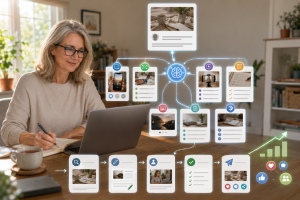
HOW TO REPURPOSE CONTENT
WITHOUT BORING YOUR AUDIENCE
There is one important warning.
Repurposing does not mean endlessly repeating exactly the same post.
People will notice.
Eventually, they may begin wondering whether you have become stuck in a loop.
Instead, change the angle.
For example, one article about email marketing could produce:
Post 1: A beginner mistake
Post 2: A personal story
Post 3: A quick tip
Post 4: A checklist
Post 5: A question
Post 6: A myth
Post 7: A short case example
All seven posts come from the same core topic.
Yet each feels different.
You can also change the opening.
For example:
“Are your emails being ignored?”
“You do not need to email every day.”
“I made this email mistake for far too long.”
“One small change can improve your emails.”
Same subject.
Different doorway.
That is one of the secrets behind effective content repurposing ideas.
KEY TAKEAWAY:
Keep the core lesson.
Change the angle, format, example, or opening.
Short Summary:
Good repurposing feels familiar but not repetitive.
HOW TO CHOOSE WHICH CONTENT TO REPURPOSE FIRST
Do not repurpose everything.
Some content deserves more attention than others.
Start with material that has already shown signs of working.
If you are unsure which results deserve attention, these marketing metrics for beginners can help you separate useful signals such as clicks, conversions, and engagement from numbers that simply look impressive.
Look for content that:
* Gets comments
* Receives shares
* Attracts website visitors
* Produces email signups
* Generates questions
* Creates clicks
* Leads to enquiries
* Continues getting attention
You can also repurpose evergreen content.
Evergreen simply means the subject stays useful for a long time.
For example:
“How to Build an Email List”
has a much longer life than:
“What Happened on Facebook Yesterday”
Your strongest evergreen content can become the backbone of your marketing.
A simple priority system can help.
HIGH VALUE + STILL RELEVANT
Repurpose first
HIGH VALUE + OUTDATED
Update, then repurpose
LOW VALUE + STILL RELEVANT
Improve before repurposing
LOW VALUE + OUTDATED
Probably leave it alone
This prevents you from multiplying weak content.
More of something poor is still poor.
Sadly, mathematics can be cruel.
KEY TAKEAWAY:
Start with useful content that has already earned attention or solves an important audience problem.
Short Summary:
Repurpose your strongest material first rather than blindly recycling everything.
BUILD A SIMPLE CONTENT REPURPOSING SYSTEM
The biggest advantage comes when repurposing becomes a routine.
A few simple content planning tools can also help you store ideas, organise drafts, schedule repurposed pieces, and stop good content disappearing into forgotten folders.
You should not need to reinvent the process every week.
For example, your system might be:
MONDAY
Publish one detailed blog post.
TUESDAY
Create two Facebook posts.
WEDNESDAY
Create one LinkedIn post and one short video.
THURSDAY
Send an email based on one lesson.
FRIDAY
Create a checklist or carousel.
WEEKEND
Review questions and results.
Then repeat.
One article has now supplied most of the week's marketing.
Naturally, your schedule can be different.
The important part is having a process.
You can also create a simple repurposing checklist.
For every new article, ask:
* Can this become social posts?
* Can it become an email?
* Can it become a video?
* Can it become a checklist?
* Can it become a carousel?
* Can it become a live session?
* Can it become part of a larger guide?
If the answer is yes, add it to your content plan.
KEY TAKEAWAY:
A repeatable system turns content repurposing from an occasional trick into a regular marketing habit.
Short Summary:
Build a routine that automatically turns every strong idea into several useful assets.
CONTENT REPURPOSING STRATEGIES
FOR BEGINNER MARKETERS
If you are just starting, keep things simple.
You do not need to use every format immediately.
That can create the very problem repurposing is supposed to solve.
Start with three channels.
For example:
BLOG
↓
FACEBOOK
↓
EMAIL
Once that feels comfortable, add another format.
Perhaps LinkedIn.
Later, you could try short video.
Progress matters more than complexity.
Beginners often get distracted by what everyone else appears to be doing.
One marketer posts five videos a day.
Another sends daily emails.
Someone else seems to be everywhere at once.
Meanwhile, you are still trying to remember your password.
That is fine.
Build your own system.
Consistency beats trying to run ten marketing channels badly.
A simple approach can still produce Internet Profit Success when each piece of content serves a clear purpose.
Focus on helping your audience.
Solve problems.
Answer questions.
Then repurpose those useful answers.
KEY TAKEAWAY:
You do not need to be everywhere.
Start with a few channels you can manage consistently.
Short Summary:
Begin small, build a repeatable process, and expand only when the system feels manageable.
CONCLUSION. MAKE CONTENT REPURPOSING STRATEGIES WORK HARDER FOR YOU
Content creation does not have to mean inventing something new every morning.
You already have more potential content than you may realise.
A blog article can become social posts.
Social posts can become emails.
Videos can become articles.
Articles can become checklists.
Audience questions can become future posts.
Several related articles can become a guide.
Meanwhile, AI can help you identify even more possibilities.
That is the real power of content repurposing strategies.
You stop treating every piece of content as a one-time event.
Instead, you build an ecosystem.
One useful idea can travel through several formats.
It can reach people who read.
Others may prefer video.
Some respond to email.
Another person may notice your message only after seeing it several times.
Repurposing gives that idea more chances to work.
Most importantly, it saves time.
For busy beginners, retirees, and entrepreneurs, that matters.
You do not need to become a content-producing machine.
You need to become better at using what you have already created.
KEY TAKEAWAY:
The goal is not simply to create more content.
The goal is to get more useful results from every good idea.
Short Summary:
Create something valuable once, adapt it intelligently, and let it continue working across your marketing.
DO THIS NOW
Do not close this article and tell yourself you will sort all this out next week.
Pick one piece of content you have already created.
Choose one idea from it.
Then turn that idea into something new today.
After that, take the next step.
If you want a simple way to see how the different parts of an online business can fit together.
There is no need to know everything first.
You do not need to be a technology expert.
Most importantly, you do not need to figure everything out alone.
Then choose one lesson.
Put it into action.
That small step could be far more valuable than another week spent thinking about getting started.
