

Content Marketing Mistakes Beginners Make (Fix These 11)
Fix These Now

THE REAL REASON THIS FEELS HARDER THAN IT SHOULD
If you’ve ever stared at a blank screen thinking, “Cool… what do I even post?” you’re in excellent company. Content is the foundation of online growth, and yet it’s also the thing that makes beginners feel like they’re trying to juggle flaming bowling pins while riding a unicycle. Meanwhile, someone on the internet is casually posting a blurry photo of their lunch and getting 900 likes. Rude.
Here’s the good news: most struggling creators aren’t “bad at content.” More often, they’re making a few common, totally fixable mistakes. Once you understand what content is supposed to do, everything gets simpler, faster, and honestly, more fun. So in this long-form guide, we’re going to walk through the most common content marketing mistakes beginners make, explain why they happen, and then fix them with practical steps and examples you can use today.
Along the way, we’ll also cover why your content isn’t working (without the doom-and-gloom), build a content calendar for beginners that actually sticks, and share plenty of call to action (CTA) examples that won’t make you feel like a late-night infomercial host. Most importantly, you’ll leave with a clear plan that helps you create content that builds trust, gets engagement, and supports real momentum, including goals like Internet Profit Success if that’s your thing.
WHAT CONTENT IS ACTUALLY SUPPOSED TO DO (SPOILER: IT’S NOT MAGIC)
A lot of frustration comes from expecting content to do a job it wasn’t hired for. Content is not a vending machine where you insert a post and receive instant results. Instead, content is more like a good conversation. It helps people understand who you are, what you believe, and whether you can help them.
In other words, content has three big roles. First, it attracts the right people by speaking to a real problem they’re dealing with. Second, it builds trust by showing you understand that problem and can guide them. Third, it moves people toward action by giving them a next step, even if that next step is small, like saving a tip or replying with a question.
However, none of that works if your content is vague, inconsistent, overly complicated, or centered on you instead of your audience. So let’s get specific and tackle the content marketing mistakes beginners make one by one, with a bunch of extra tools to make the fixes stick.
If your titles still feel a bit “meh,” steal a few patterns from headline formulas that grab attention so the right people actually click.
THE QUICK OVERVIEW
Before we zoom in, here’s the short version of what usually goes wrong. Beginners often talk about themselves instead of the reader. They pack way too much information into one post. They copy other creators until their content has the personality of plain oatmeal. They wait for inspiration like it’s a bus that’s definitely coming (but somehow never arrives). They avoid asking for any action because they’re afraid of sounding pushy. Finally, they expect content alone to do all the heavy lifting, even though relationships and follow-up are where the real magic happens.
Meanwhile, these mistakes stack on top of each other. When you post inconsistently, you don’t learn what works. When you cram too much into one post, people bounce. When you don’t include a next step, the right people don’t move closer. So yes, it can feel like “why your content isn’t working” is a mystery, but it’s usually just a few levers that need adjusting.
Now let’s fix them properly.
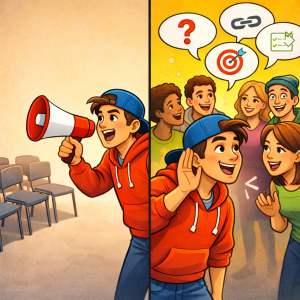
THINKING CONTENT SHOULD BE ABOUT YOU
This is the classic beginner trap: you write what you feel like saying instead of what your audience needs to hear. It’s not because you’re selfish. It’s because you’re human, and your brain is trying to make content creation easier by talking about what you know best, you.
On the other hand, the internet rewards relevance, not autobiography. People don’t wake up thinking, “I hope someone posts their morning routine today.” They wake up thinking, “How do I stop feeling overwhelmed?” or “Why isn’t this working?” or “How do I do this without looking clueless?”
So here’s the shift. Your content can include you, but it should be for them. Your story becomes useful when it connects to their problem and gives them a takeaway.
Example: instead of posting “I’m building my business and I’m so excited,” you could post, “I used to feel totally overwhelmed trying to do everything at once. Here’s the one simple thing I did to stop spinning my wheels.” Same life, different angle, way more helpful.
Try this quick prompt method. Ask: What is my audience struggling with today? What do they wish they could fix in the next 30 days? What’s the mistake they keep making because nobody explained the basics?
Then write to that. As a result, your posts become magnets for the right people instead of a diary entry that only your mom fully appreciates. If you’re not totally sure who you’re talking to yet, start with these ideal customer profile questions and use the exact phrases people say out loud.
TRYING TO EDUCATE TOO MUCH IN ONE POST
When beginners care a lot, they tend to over-deliver. It’s like you’re trying to cook someone dinner, and you bring them a 12-course tasting menu on a Tuesday. It’s impressive, sure, but it’s also a lot.
The problem is simple: too much information creates overwhelm. Overwhelm creates inaction. Inaction creates “nice post!” and then they disappear forever like a magician with commitment issues.
Instead, focus on one idea per post. One clear takeaway. One small win. Meanwhile, you can always build a series from a bigger topic.
Let’s say you want to teach email basics. A beginner mistake is writing “Everything about email marketing for beginners.” That’s basically a textbook wearing a trench coat.
A better approach is splitting it into a mini-series:
Post 1: The first email you should write and why it matters.
Post 2: One easy way to get more opens without being gimmicky.
Post 3: A simple welcome sequence structure you can copy.
See the difference? Each piece is snackable, clear, and doable. In addition, your audience is more likely to come back for the next part because you didn’t melt their brain in part one.
A helpful rule: if your post has more than three “and then also” moments, it’s probably multiple posts pretending to be one.

COPYING OTHER CREATORS WITHOUT YOUR OWN ANGLE
It’s normal to learn by watching others. Still, copying without developing an angle creates generic content that blends into the noise. The internet has plenty of “how to be successful” posts. It doesn’t need another one that sounds like it was written by a motivational poster.
Your advantage is your perspective. Your voice. Your lived experience. Even if you’re new, you still have something valuable: the fresh memory of what confused you, what helped you, and what you wish someone explained sooner.
So how do you build an angle? Start by choosing one “lens” you like to teach through. For example:
You might be the “simple systems” person.
Alternatively, you might be the “no-fluff, tell me exactly what to do” person.
On the other hand, you might be the “storytelling and mindset” person.
Once you pick a lens, your content naturally becomes more distinct. Even basic topics feel new when you filter them through your approach.
Here’s a practical exercise. Write down three moments that shaped how you think:
A mistake you made.
A myth you believed.
A breakthrough you had.
Now turn each into a lesson for your audience. For example: “I used to copy big creators and still got zero engagement. Here’s what changed when I started sharing my own beginner-friendly take.”
That’s not just content. That’s connection.

CREATING ONLY WHEN YOU FEEL INSPIRED
Inspiration is great. It’s also wildly unreliable, like a friend who says they’re “five minutes away” but hasn’t left the house. If your plan is to create content only when you feel motivated, your consistency will look like a heartbeat monitor during a nap.
Successful creators rely on systems, not vibes. Even a simple system can change everything. Meanwhile, consistency isn’t about posting 97 times a day. It’s about showing up regularly enough that people remember you exist.
This is where a content calendar for beginners becomes your best friend. Not a complicated spreadsheet that makes you cry, but a simple weekly rhythm.
For example, you can rotate four easy post types:
1. A tip: one practical move someone can use today.
2. A story: a struggle, lesson, or before-and-after moment.
3. A myth buster: something beginners believe that’s holding them back.
4. A how-to: a short process with clear steps.
Then batch your work. One hour to brainstorm, one hour to draft, one hour to polish and schedule. Suddenly you’re not “creating daily,” you’re “preparing weekly,” which is much more doable.
Also, keep an “idea parking lot.” Whenever a question pops up, drop it in. Over time, you’ll stop running out of topics because your audience is basically writing your content calendar for beginners without realizing it.
NOT INCLUDING A CLEAR NEXT STEP
A post without a next step is like giving someone directions and then saying, “Good luck, buddy,” and driving away. People often need guidance on what to do after they read your content.
Beginners avoid this because they’re afraid of sounding pushy. Ironically, a clear next step usually feels helpful, not salesy. It’s only weird when it’s random or aggressive.
Instead, match the next step to the content.
When the post teaches a quick tactic, your CTA can be, “Try this today and tell me how it goes.”
Where the post shares a lesson, your CTA can be, “If you relate, share what part you’re working on.”
If the post introduces a tool, your CTA can be, “Want a simple checklist? Ask and I’ll share the outline.”
You can also use call to action (CTA) examples that fit naturally into conversation:
“Save this so you can use it later.”
“Send this to a friend who’s stuck.”
“Want part two? Say the word.”
“Tell me which step you’re on right now.”
Notice how these feel like a human talking, not a robot trying to close a deal. Additionally, CTAs help you learn what your audience wants, because their responses become your next content topics.
EXPECTING CONTENT TO DO ALL THE WORK
Content is powerful, but it’s not the entire strategy. If you post and then disappear, you’re leaving results on the table. People buy from people they trust, and trust is built through interaction, follow-up, and consistency over time.
Think of content like the invitation. The relationship happens after.
So what should you do besides posting? Engage. Have conversations. Follow up. Build a simple nurture system. If you’re building from scratch, this guide on how to build trust with a cold audience is basically the online version of a warm handshake.
For example, if someone replies to your post with a question, answer it thoughtfully. If they share a struggle, respond like a human, not like a brochure. Meanwhile, keep a list of common questions you receive. Those questions are proof of demand, and they turn into great posts later.
Also, don’t ignore your existing audience. A small group of engaged people beats a huge group of silent scrollers every day of the week. In addition, content works best when paired with a basic follow-up path, whether that’s a newsletter, a guide, or a simple sequence that helps people take the next step.
If your goal is Internet Profit Success, that success usually comes from a mix of solid content plus real connection, not content alone acting like a magical money printer. Content opens the door. Relationships keep it open.
A FAST DIAGNOSIS THAT DOESN’T HURT YOUR FEELINGS
If you’re thinking, “Okay, but why your content isn’t working for me specifically?” let’s do a quick diagnosis. Most problems fall into a few buckets.
Sometimes the content is about you, not them. In that case, your engagement stays low because people don’t feel seen.
Other times the content is too broad. If your advice could apply to literally anyone, it will resonate with almost no one. Specific is sticky.
In some cases, the content is helpful but confusing. Long paragraphs, multiple ideas, and unclear structure can bury your message.
Alternatively, the content may be decent, but you’re inconsistent, so the algorithm and the audience both forget you exist.
Another common issue is that your posts end with no next step, so nobody knows what to do. Finally, you may be posting but not engaging, which makes it harder to build trust.
The fix is not “post more.” The fix is “post better, consistently, with a system.” Then, once someone raises their hand, a simple email nurture sequence keeps the relationship moving without you living in your inbox.
So let’s add a few new sections that make this even easier.
PICKING TOPICS THAT DON’T LAND
A surprising number of creators struggle because they’re talking about the wrong things. They pick topics based on what they think sounds impressive instead of what their audience actually needs.
For example, beginners will post about advanced strategies when their audience is still trying to understand basics. That’s like teaching someone to drift a car when they haven’t learned where the brake pedal is.
Instead, aim for “pain-to-solution” topics. Focus on the real frustrations your audience is dealing with right now. If you’re secretly expecting instant results (we’ve all been there), these internet marketing myths will save you a ton of unnecessary stress-snacking.
Here are topic angles that almost always work:
Common beginner confusion: “If you’re new and overwhelmed, start here.”
Simple frameworks: “Use this 3-step method to keep it easy.”
Mistakes and fixes: “If this isn’t working, try this instead.”
Before-and-after stories: “Here’s what changed when I did X.”
Myth busting: “You don’t need to do this to get results.”
Meanwhile, keep your language simple. People don’t want a lecture. They want clarity. And when you want trust to show up faster, sprinkle in a few types of social proof so people can see you’re real, consistent, and actually helpful.
To find better topics, listen for patterns. What do people ask you repeatedly? What do you see beginners struggling with in groups? What did you personally struggle with six months ago? That’s your content gold.
A SIMPLE WEEKLY SYSTEM THAT BUILDS MOMENTUM
Let’s build a content calendar for beginners that doesn’t require color-coded tabs and a minor in project management. You want something easy enough to stick with, but structured enough to keep you consistent.
Start with themes. Pick three to five buckets you can rotate:
Beginner tips
Story lessons
Behind-the-scenes process
Common mistakes
Simple how-tos
Now assign them to days if you like, but keep it flexible. For example:
Monday: tip
Wednesday: story
Friday: mistake and fix
Weekend: Q&A or behind-the-scenes
Next, batch your ideas. Spend 20 minutes listing 20 post ideas. Then spend 60 minutes drafting a few at once. After that, polish later. The goal is to separate “thinking” from “writing.” When those happen at the same time, your brain tends to panic.
Also, build a repurposing habit. If a post performs well, you can turn it into:
1. A shorter version
2. A story version
3. A step-by-step version
4. A Q&A version
As a result, you stop reinventing the wheel every time you post. When you turn your best ideas into longer posts, run them through this blog post SEO checklist so they’re easy to skim and built to rank.

WRITING LIKE A TEXTBOOK INSTEAD OF A HUMAN
This mistake doesn’t get talked about enough. You can have great ideas and still lose people because the writing feels stiff. Casual, clear writing wins online because it’s easy to digest.
So write like you talk. Use contractions. Use short sentences mixed with longer ones. Toss in a light joke if it fits. Keep the reader moving.
Meanwhile, make your point quickly. If it takes five paragraphs to get to the lesson, people scroll away. A useful habit is “front-load the value,” then expand.
Example:
Instead of: “In today’s post, I want to share some thoughts about content…”
Try: “If your posts aren’t landing, you probably need to simplify one thing.”
That small shift keeps attention.
Need stronger openers? Steal a few starters from these scroll stopping hooks for engagement so your first line doesn’t read like a sleepy school newsletter.
Also, avoid trying to sound like an expert by using complicated language. Clarity is what makes you sound confident. Confusion makes you look unsure, even if you know your stuff.
NOT USING SPECIFIC EXAMPLES (AND LOSING TRUST)
Advice without examples feels like a fortune cookie. Cute, but not actionable.
When you make a claim, prove it with a simple example. This builds trust and helps people apply what you’re teaching.
For instance, if you’re teaching audience-first content, give a before-and-after:
Before: “Stay consistent and you’ll grow.”
After: “Pick two days a week to post and use the same four themes so you never run out of ideas.”
If you’re teaching simplicity, show what that looks like:
Complicated: “Here are 14 ways to optimize your content strategy.”
Simple: “Pick one problem, give one fix, end with one next step.”
Also, if your posts look like they were designed during a power outage, this will help you make your content look professional with quick, beginner-friendly tweaks.
If you’re teaching unique angle, demonstrate it:
Generic: “Storytelling matters.”
Specific: “Tell the story of the moment you almost quit, then share the one small change that helped you keep going.”
Examples turn your content from theory into a tool.
REPURPOSING THE WRONG WAY (OR NOT AT ALL)
Repurposing is a cheat code, but beginners often do it in one of two unhelpful ways. They either never repurpose and burn out, or they repost the exact same thing until their followers can recite it like song lyrics.
Smart repurposing keeps the core idea but changes the angle.
Let’s say you wrote a post about consistency. Here are four repurpose angles:
1. A mistake: “The consistency trap that keeps beginners stuck.”
2. A how-to: “My 15-minute weekly content system.”
3. A story: “I stopped waiting for motivation and everything changed.”
4. A Q&A: “Do you need to post daily? Nope, here’s why.”
To stretch one idea into a week of content without burning out, use content repurposing for SEO to remix your best stuff into multiple formats.
Meanwhile, repurposing can also mean changing formats. You can turn one strong idea into a short story, a checklist-style explanation, and a simple “do this today” tip. That gives you variety without forcing you to invent new ideas nonstop.
If your goal is steady growth, repurposing is how you stay consistent without hating your life. In addition, building a base of evergreen content types means your best ideas keep working long after the original post disappears from the feed.
CALL TO ACTION (CTA) EXAMPLES THAT FEEL NATURAL, NOT WEIRD
A lot of people hear “CTA” and immediately picture a pushy pitch. In reality, call to action (CTA) examples can be gentle and still effective.
The key is matching the CTA to the reader’s readiness. Some people are brand new and just need a simple first step. Others want a resource. Some want a conversation.
Here are call to action (CTA) examples you can rotate without sounding robotic:
“If you want part two, tell me and I’ll write it.”
“Try this today and let me know what happens.”
“Which one of these are you struggling with most?”
“If you’re stuck, describe your situation and I’ll suggest a simple next step.”
“Save this for the next time you feel overwhelmed.”
Also, use “soft asks” when you’re building trust. A soft ask is any CTA that invites interaction without pressure. Meanwhile, as your audience warms up, you can use stronger CTAs that guide them toward a resource or next step.
Most importantly, don’t apologize for having a next step. Helping people take action is the whole point. If you want plug-and-play phrasing you can rotate all month, swipe these CTA templates that boost click-throughs and tweak them to match your voice.

MEASURING THE WRONG THINGS AND GETTING DISCOURAGED
If you measure the wrong metrics, you’ll feel like you’re failing even when you’re improving. Beginners often obsess over likes and views, which can be wildly inconsistent.
Instead, watch for these “real” progress signals:
1. More replies and questions
2. More saves and shares
3. More profile visits after posting
4. More conversations started
5. More consistency in your own output
Meanwhile, track your content in a simple way. After each post, write down:
Topic
Angle (tip, story, mistake, how-to)
CTA used
What response you got
If you want to track progress without drowning in data, start with these marketing metrics for beginners and ignore the vanity fluff.
After a month, patterns show up. You’ll notice which topics drive engagement and which CTAs get replies. As a result, your content calendar for beginners becomes smarter over time.
Also, remember that some posts are “relationship builders.” They won’t go viral, but they deepen trust with the right people. Those posts matter more than you think.
A 30-DAY RESET PLAN TO FIX CONTENT FAST (WITHOUT POSTING 12 TIMES A DAY)
If you want a simple plan to clean this up, use this 30-day reset. It’s designed to fix the most common content marketing mistakes beginners make while keeping your workload reasonable.
Week 1: Audience-first reboot
Write three posts that focus on a specific struggle your audience has.
Add one example in each post.
End each with a simple CTA.
Week 2: Simplify and split
Take one big topic and turn it into three smaller posts.
Keep each post to one takeaway.
Test different CTAs to see what gets replies.
Week 3: Angle and story
Write two posts that share a mistake you made and the lesson it taught you.
Write one “myth buster” post that challenges a common beginner belief.
Keep your tone conversational and clear.
Week 4: System and repurpose
Create a content calendar for beginners using 3 to 5 theme buckets.
Repurpose your best post into two new angles.
Engage daily for 10 minutes: reply, ask questions, and start conversations.
By the end of 30 days, you’ll have clarity on why your content isn’t working, plus proof of what does work for your audience.
FAQ: CONTENT MARKETING MISTAKES BEGINNERS MAKE (AND QUICK FIXES)
How often should I post?
Consistency matters more than frequency. If you can post two or three times a week and stay consistent, that beats seven days a week for one week and then vanishing for a month.
Do I need to be an expert to create helpful content?
Not at all. Beginners can teach beginners. Share what you’re learning, what’s working, and what you wish someone explained earlier. That perspective is valuable.
What if my content feels boring?
Usually it’s missing specificity and examples. Add a real scenario, a quick story, or a clear step-by-step. Also, your audience doesn’t need fireworks. They need clarity.
Why do I get views but no engagement?
Often, your post doesn’t include a next step. Use call to action (CTA) examples that invite an easy response. Questions, “try this,” and “which one are you stuck on” work well.
What if I have no ideas?
You have ideas. They’re hiding in your daily life. Pay attention to what confuses you, what questions you get, and what you’re currently trying to improve. Then write about that.
CONCLUSION: KEEP IT SIMPLE, KEEP IT USEFUL, KEEP IT YOU
Most content struggles aren’t caused by a lack of talent. They come from a handful of fixable issues: talking about yourself instead of the audience, overstuffing posts, copying without an angle, waiting for inspiration, skipping a next step, and expecting content to do everything alone. Once you correct those content marketing mistakes beginners make, content stops feeling like a daily stress monster and starts feeling like a tool you control.
Meanwhile, the path forward doesn’t need to be complicated. Choose audience-first topics, deliver one clear takeaway, add specific examples, use a content calendar for beginners to stay consistent, and include natural next steps with simple call to action (CTA) examples. Over time, you’ll learn what resonates, you’ll build trust faster, and you’ll create a system that supports bigger goals, including Internet Profit Success, without turning your life into a never-ending content treadmill.
So yes, your content can work. It just needs to be built like a bridge, not a billboard. Keep showing up, keep it human, and keep making it easier for your audience to take the next step.
