

5 Facebook Ad Testing Ideas Beginners Should Try First
Ad Testing Tips That Reveal What Works

Introduction to Facebook Ad Testing Ideas
Facebook advertising can feel like trying to cook dinner while the smoke alarm is yelling at you.
You think you followed the recipe.
You picked an audience, wrote a nice little ad, added an image, pressed publish, and waited for the magic to happen.
Then, instead of a flood of clicks, leads, and happy little notification pings, you get silence.
Awkward silence.
However, this does not always mean Facebook ads do not work.
More often, it means the ad has not been tested properly yet.
That is where Facebook ad testing comes in.
Facebook ad testing is the process of running different versions of your ads to see what works best.
Instead of guessing, you compare headlines, images, videos, audiences, calls to action, and landing pages.
Then, bit by bit, you learn what gets attention and what makes people take the next step.
For beginners, this is huge.
You do not need to be some tech wizard sitting in a dark room with six monitors and a giant coffee mug.
You just need a simple testing plan.
In this guide, we will walk through five Facebook ad testing ideas beginners should try first.
Along the way, you will see examples, tips, mistakes to avoid, and a few ways to make the whole thing less confusing.
Why Facebook Ad Testing Matters So Much
Facebook ad testing matters because people are unpredictable.
One headline may look perfect to you, but your audience may ignore it like a cold slice of gas station pizza.
Another headline may feel simple, almost too simple, but suddenly it gets more clicks.
That is the power of testing.
Instead of relying on personal opinion, Facebook ad testing lets the numbers tell the story.
That same mindset matters in paid advertising for beginners, because clicks alone rarely tell the whole story.
You are not trying to be psychic.
You are trying to spot patterns.
For example, one audience might respond better to curiosity.
Another might prefer a direct benefit.
Meanwhile, a third group may only react when the visual grabs them in the first second.
Without testing, you may never know which part of your ad is helping or hurting.
In addition, Facebook ads A/B testing gives beginners confidence.
When you see that one version clearly performs better than another, you start making smarter decisions.
Over time, this can help improve click-through rates, reduce wasted ad spend, and make campaigns easier to manage.
The goal is not to create a perfect ad on day one.
Honestly, that almost never happens.
The goal is to build better ads by learning from real results.
The Big Beginner Mistake With Facebook Ads
Many beginners make the same mistake.
They create one ad, launch it, and hope for the best.
At first, this feels logical.
After all, creating one ad is faster and easier than creating several versions.
However, the problem is that one ad gives you very little information.
If the ad does poorly, what caused the problem?
Was the headline weak?
Did the image fail to stop the scroll?
Was the audience too broad?
Did the landing page confuse people?
Nobody knows.
It becomes a guessing game, and guessing with ads can get expensive fast.
On the other hand, Facebook ad split testing helps you isolate the issue.
When you test one thing at a time, you can see what changed the outcome.
For instance, if two ads have the same image, same audience, and same landing page, but different headlines, you can compare the headlines more fairly.
That is why beginners should not try to test everything at once.
Doing that creates a messy bowl of spaghetti data, and nobody wants to untangle that.
Instead, start small.
Test one element, learn from it, then move to the next.
Facebook Ad Testing Starts With One Clear Goal
Before running any Facebook ad testing campaign, choose one clear goal.
This sounds boring, but it matters.
If you do not know what you are trying to improve, you will not know which result matters most. One person may be chasing clicks. Another may want leads. Someone else may care most about purchases or signups.
Each goal can change how you judge your test.
That is why it helps to understand Facebook ads for beginners before you decide what your campaign should measure.
For example, if your goal is traffic, click-through rate matters a lot.
If your goal is leads, then cost per lead and conversion rate become more important.
Meanwhile, if your campaign is designed to build awareness, engagement may be useful too.
A beginner promoting a simple guide, training, or Internet Profit Success style resource might want people to visit a landing page and sign up.
In that case, the ad click is only part of the story.
The landing page result matters too.
So, before you test headlines, images, audiences, or CTAs, ask yourself what success looks like.
A clear goal keeps you focused.
It also stops you from celebrating the wrong result, like getting lots of cheap clicks from people who never take action.
What To Track Before You Change Anything
Once your goal is clear, decide what numbers you will track.
This is where many beginners get overwhelmed, because Facebook gives you a lot of metrics. Some are useful. Others are just shiny distractions wearing a fancy hat.
For most beginners, a few simple numbers are enough.
Click-through rate shows how many people clicked after seeing the ad. Cost per click shows how much each click costs. Conversion rate shows how many people took the next step after clicking.
In addition, cost per lead or cost per result can show whether the campaign is moving in the right direction.
However, do not stare at one number alone. A cheap click is not always a good click. A high click-through rate is not always a winning ad if nobody converts after landing on the page.
That is why Facebook ad testing works best when you look at the full journey.
People see the ad, click it, visit the page, and decide what to do next.
Each step matters.
As a beginner, keep a simple testing sheet. Write down the ad version, what you changed, the date, and the main results. This prevents confusion later when every ad starts looking like a clone wearing a different hat.
Facebook Ad Testing Idea 1
Test Your Headlines
The headline is one of the first things people notice.
Sometimes, it is the reason they stop scrolling.
Other times, it is the reason they keep scrolling like your ad never existed.
That is why headline testing is one of the easiest places to begin.
For stronger first lines, these ad copywriting tips can help you turn a plain idea into something people actually notice.
With Facebook ad testing, you can create two or three versions of the same ad and only change the headline.
Everything else should stay the same.
For example, one headline might focus on curiosity.
Another could focus on a clear benefit.
A third might ask a question.
This allows you to see which angle attracts your audience most.
A curiosity headline might say something like, “The Simple Ad Test Most Beginners Skip.”
A benefit-focused headline could say, “Improve Your Facebook Ads With 5 Simple Tests.”
Meanwhile, a question headline might ask, “Are Your Facebook Ads Failing Because Of This?”
Each one speaks differently.
None is automatically best.
The audience decides.
In addition, headline tests are fast to create.
You do not need new graphics, new pages, or a complicated setup.
You just need different wording.
That makes this a smart first move for beginners.

Headline Examples For Facebook Ad Testing
Good headlines are clear, specific, and interesting.
They should make people curious without sounding like a cheesy late-night infomercial.
For example, instead of saying, “Great Facebook Ad Tips,” you could say, “5 Facebook Ad Testing Tips Beginners Usually Miss.”
The second version is stronger because it is more specific.
It tells the reader what they will get and who it is for.
Another example might be, “Why Your First Facebook Ad Probably Needs A Test.”
That headline speaks directly to beginners who may feel unsure.
On the other hand, a headline like “Crush Your Ads Today” sounds vague.
It may feel exciting, but it does not tell the reader much.
When writing headlines, try different angles.
For more opener ideas, these social media hook templates can help you create scroll-stopping angles without staring at the screen all afternoon.
Use a curiosity angle, such as “The Tiny Ad Change That Can Reveal A Lot.”
Use a mistake angle, such as “5 Facebook Ad Testing Mistakes Beginners Should Avoid.”
OR Use a benefit angle, such as “Simple Facebook Ad Testing Strategies To Improve Results.”
Also, keep headlines easy to read.
Big words may look clever, but confused people rarely click.
Your job is not to sound fancy.
Your job is to get attention and make the next step feel obvious.
Facebook Ad Testing Idea 2
Test Images And Videos
Visuals are scroll-stoppers.
People move through Facebook quickly, often while half-watching TV, drinking coffee, or pretending to listen during a meeting.
So, your image or video has to work hard.
That is why testing visuals is a major part of Facebook ad testing.
An ad with a weak image may get ignored even if the copy is great.
Meanwhile, a strong visual can make people pause long enough to read the message.
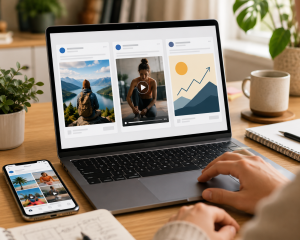
Start by testing two or three different creative styles.
One version could use a clean graphic.
Another might use a human face.
A third could use a short video or simple demonstration.
Keep the headline, audience, and offer the same so the visual is the main difference.
For example, an ad promoting beginner online business training might test a laptop image against a short video of someone explaining a simple tip.
Another version could use a graphic showing a basic three-step process.
Each visual creates a different feeling.
In addition, videos can be powerful because movement catches the eye.
However, images can still work well, especially when they are clear and easy to understand.
Do not assume video always wins.
Test it.
How To Choose Visuals That Stop The Scroll
Strong visuals usually do one thing well.
They communicate a clear idea quickly.
If someone needs ten seconds to understand your image, you may have already lost them.
Facebook moves fast.
Your visual should make sense almost instantly.
For Facebook ad testing, choose visuals that match the message of the ad.
If the ad is about beginner-friendly training, avoid images that look too advanced or corporate.
A giant dashboard full of charts may scare beginners away.
Instead, use visuals that feel simple, relatable, and welcoming.
For example, a person working at a laptop can work if it feels natural.
A simple checklist graphic can work too.
A short video showing a quick tip may also perform well.
However, avoid clutter.
Too much text, too many icons, or too many colors can make the ad feel messy.
In addition, test emotional tone.
A calm image may attract one audience, while an energetic video may attract another.
Small details can matter more than expected.
Background color, facial expression, camera angle, and even the first frame of a video can change results.
Basically, visuals are not decoration.
They are part of the message.
Treat them like they matter, because they do.
Facebook Ad Testing Idea 3
Test Your Audience
Even the best ad can flop if the wrong people see it.
That is why audience testing is one of the most important Facebook ad testing strategies for beginners.
Think of it like telling a joke.
If you tell a cat joke to dog people, the room may get weird fast.
The same idea applies to ads.
Your message needs the right audience.
If audience setup still feels fuzzy, this guide to ad targeting for beginners fits naturally as the next step.
To test audiences, create separate ad sets with the same ad creative.
Keep the headline, image, copy, and landing page the same.
Only change the audience.
For example, one audience might be interested in entrepreneurship.
Another might be interested in digital marketing.
A third might focus on people interested in working from home or learning new skills.
Then, compare the results.
Which audience clicks more?
Which one costs less to reach?
Which one converts better after clicking?
This helps you avoid blaming the ad when the real problem is targeting.
In addition, audience testing can reveal surprising results.
Sometimes the audience you expect to win does not win.
Other times, a smaller or more specific group performs better.
That is why testing beats guessing.

Audience Examples For Facebook Ad Split Testing
Audience testing works best when each audience has a clear reason behind it.
Random targeting is not a strategy.
It is just throwing spaghetti at a wall and hoping dinner appears.
For example, if you are promoting beginner-friendly online business education, you might test different interest groups.
One audience could include people interested in entrepreneurship.
Another could include people interested in online learning.
A third could include people interested in side businesses or digital tools.
Each group is related, but each has a slightly different mindset.
The entrepreneurship audience may respond to freedom and independence.
The online learning audience may respond to step-by-step education.
Meanwhile, the side business audience may care about simplicity and fitting things around a busy schedule.
In addition, you can test warm audiences if you have them.
These might include people who visited your website, watched your videos, or engaged with your page.
Warm audiences often behave differently from cold audiences because they already know you a little.
However, beginners may not have big warm audiences yet.
That is fine.
Start with interest-based audiences and learn as you go.
Over time, your testing data becomes a map.
It shows you where the better opportunities are hiding.
Facebook Ad Testing Idea 4
Test Your Call To Action
The call to action, or CTA, tells people what to do next.
A simple review of call to action best practices can help you make that next step clearer.
It may seem like a small detail, but small details can be sneaky little troublemakers.
One CTA might feel natural.
Another might feel too pushy.
A third might be too vague.
That is why CTA testing belongs in every beginner Facebook ad testing plan.
For example, you could test “Learn More” against “Get The Guide” or “See The Steps.”
Each phrase creates a slightly different expectation.
“Learn More” feels soft and low-pressure.
“Get The Guide” feels more direct.
“See The Steps” suggests useful information is waiting on the other side.
The best CTA depends on the audience and the offer.
However, do not change too many things at once.
If you are testing the CTA, keep the rest of the ad the same.
Also, make sure the CTA matches the landing page.
If the ad says “Get The Guide,” the landing page should clearly present the guide.
If the ad says “Watch The Training,” the page should not make people hunt for a video like they are solving a mystery.
Clarity wins.
Simple CTA Examples For Facebook Ads A/B Testing
A good CTA should feel like the next logical step.
It should not confuse people, pressure them too hard, or sound like a robot wrote it after three energy drinks.
For Facebook ads A/B testing, try a few CTA styles.
A learning CTA could say, “Learn the basics.”
A curiosity CTA could say, “See how it works.”
Or a resource CTA could say, “Get the beginner guide.”
A confidence-based CTA could say, “Start with the simple steps.”
Each one creates a different feel.
For beginners, softer CTAs often work well because the audience may not be ready for a big decision yet.
They may simply want to understand more.
In addition, test CTA placement in your ad copy.
You can mention the next step near the end, but you may also test a version that introduces it earlier.
For example, one ad might tell a short story first and invite action at the end.
Another might start by saying, “Here is a simple guide that shows you what to test first.”
Neither version is automatically better.
Once again, the audience decides.
A strong CTA removes friction.
It helps people think, “Okay, that sounds useful.
I know what to do next.”
That is exactly what you want.
Facebook Ad Testing Idea 5
Test Your Landing Page
Sometimes the ad is not the real problem.
This is a painful truth, but an important one.
Your ad may get clicks, but if the landing page does not convert, results can still look bad.
That is also why fixing common landing page mistakes should be part of your testing plan.
That is why landing page testing is a key part of Facebook ad testing.
Think of the ad as the invitation and the landing page as the party.
If the invitation looks fun but the party is awkward, people leave.
A landing page should continue the same message from the ad.
If the ad promises beginner-friendly steps, the landing page should immediately show beginner-friendly steps.
No confusion.
No weird detour.
No “Where am I?” moment.
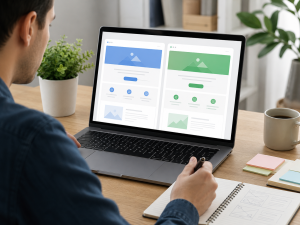
Start by testing simple page elements.
Try a different headline.
Test a shorter form.
Use a clearer call to action.
Adjust the opening section so it matches the ad more closely.
For example, one page headline might say, “Start Testing Your Facebook Ads The Simple Way.”
Another might say, “5 Beginner Ad Tests That Show What Works.”
Both are related, but they create different expectations.
In addition, landing page testing can reveal whether people need more explanation or less.
Some audiences want details.
Others want speed.
Testing helps you find the balance.
Landing Page Tweaks For Facebook Ad Testing
Landing pages do not need to be fancy.
In fact, simple pages often work better for beginners because they are easier to understand.
When doing Facebook ad testing, review your landing page like a visitor seeing it for the first time.
Is the headline clear?
Does the page explain what the person gets?
Is the CTA easy to find?
Does the page load quickly?
Are there too many distractions?
A common beginner mistake is sending people to a page with too much going on.
The visitor sees menus, sidebars, popups, giant blocks of text, and suddenly their brain packs a suitcase and leaves.
Instead, focus the page on one action.
If the goal is to get a signup, make that the obvious next step.
In addition, match the language from the ad.
If your ad uses the phrase “Facebook ad testing,” use that phrase on the page too.
This creates message consistency.
Also, test benefit-focused headlines.
A headline like “Download Our PDF” is not very exciting.
However, “Learn 5 Simple Facebook Ad Tests To Improve Your Campaigns” gives people a better reason to care.
Small page changes can create big improvements, especially when the ad is already getting decent clicks.
How Long Should A Facebook Ad Split Test Run?
A Facebook ad split test needs enough time to collect useful data.
Stopping too early can lead to bad decisions.
For example, one ad might get a few quick clicks and look like the winner.
Then, after more people see it, performance may drop.
On the other hand, an ad that starts slowly might improve once Facebook has more data.
That is why patience matters.
As a beginner, avoid making changes every five minutes.
I know it is tempting.
Watching ads run can feel like staring at bread in the toaster.
However, constant changes can disrupt learning and make your data messy.
A simple approach is to let a test run until each version has enough impressions and clicks to compare fairly.
The exact amount can vary depending on budget and audience size, but the key is to avoid judging from tiny numbers.
For example, if one ad has three clicks and another has five, that is not enough to declare a champion.
You need more data before making decisions.
In addition, look for patterns across multiple metrics.
Do not choose a winner based only on one lucky moment.
Good testing is calm, patient, and slightly less dramatic than checking your phone every twelve seconds.
Facebook Ads A/B Testing Without Overcomplicating It
Facebook ads A/B testing sounds technical, but the basic idea is simple.
You compare version A against version B.
That is it.
The tricky part is staying disciplined.
Beginners often get excited and change the headline, image, audience, CTA, and landing page all at once.
Then, when one version wins, they have no idea why.
Instead, test one main thing at a time.
If you are testing headlines, only change the headline.
Or if you are testing images, only change the image.
If you are testing audiences, keep the ad the same and change the audience.
This makes the result easier to understand.
In addition, keep your tests organized.
Give each ad a clear name so you can remember what it was designed to test.
For example, you might name one ad “Headline Test Curiosity” and another “Headline Test Benefit.”
That may not sound thrilling, but future you will be grateful.
Trust me, future you does not want to open Ads Manager and see five ads named “New Ad Copy Final Version 3 Really Final.”
That way lies madness.
Simple naming and clean testing make everything easier.
Common Facebook Ad Testing Mistakes To Avoid
A few common mistakes can ruin Facebook ad testing before it has a chance to help.
When results look messy, this breakdown of why Facebook ads not working happen can help you diagnose the weak spot before rebuilding everything.
The first mistake is testing too many things at once.
As mentioned earlier, this makes your results hard to read.
Another mistake is using weak differences.
If two headlines are almost identical, the test may not teach you much.
For example, testing “Learn Facebook Ads Today” against “Learn Facebook Advertising Today” is not a very useful comparison.
Instead, test different angles.
Curiosity versus benefit.
Question versus statement.
Short headline versus longer headline.
A third mistake is ignoring the landing page.
If people click but do not convert, the ad may not be the only issue.
In addition, many beginners stop tests too quickly.
A few early results can be misleading.
Finally, some people chase cheap clicks instead of quality results.
A low cost per click feels nice, but it only matters if the traffic is useful.
The better question is not always, “Which ad got the cheapest click?”
A stronger question is, “Which ad brought people most likely to take the next step?”
That mindset leads to better decisions.
A Simple Weekly Facebook Ad Testing Routine
A weekly testing routine can make the whole process easier.
Instead of randomly changing ads whenever panic strikes, set a simple schedule.
At the start of the week, choose one thing to test.
For example, you might test three headlines.
Next, launch the test and let it run without constant fiddling.
During the week, check the results, but do not obsess.
You are gathering information, not trying to hypnotize the screen.
At the end of the week, review the main numbers.
Which version had the best click-through rate?
Which had the best cost per result?
And which brought better landing page conversions?
Then, choose what to test next.
For example, once you find a strong headline, you might keep that headline and test different images.
After that, you could keep the winning headline and image, then test audiences.
This creates steady progress.
In addition, it keeps you from feeling overwhelmed.
You always know what you are testing and why.
Over time, each test builds on the last one.
That is how beginners start turning random ad attempts into a smarter system.
Using ChatGPT For Facebook Ad Testing Ideas
ChatGPT can be a useful helper for Facebook ad testing, especially when you need fresh ideas.
For example, you can ask it to write headline variations for a specific audience.
You might say, “Write five Facebook ad headlines for beginners who want to learn simple ad testing.”
Then, choose the best options and test them.
In addition, you can use ChatGPT to create different angles.
Ask for curiosity-based headlines, benefit-based headlines, question-based headlines, or mistake-focused headlines.
You can also ask for visual ideas.
For instance, “Suggest three image concepts for a Facebook ad about beginner ad testing.”
This can help you move faster when your brain feels like a browser with 47 tabs open.
However, do not blindly use every suggestion.
Review the ideas and make sure they fit your audience, offer, and brand voice.
Also, keep the language natural.
Ads that sound too robotic may not connect well.
ChatGPT is a tool, not a magic wand.
It can help you create testing options, but the results still come from real audience behavior.
That is why testing remains important.
Extra Facebook Ad Testing Tips For Beginners
Small improvements can add up.
One useful tip is to test angles before testing tiny wording changes.
If you want more ideas for curiosity, trust, and urgency, study these psychological triggers in advertising before writing your next test.
Big angles usually teach you more.
For example, compare a pain-based message against a benefit-based message.
Then, once you know which angle works, test smaller headline tweaks.
Another tip is to avoid copying competitors too closely.
You can learn from other ads, but your audience may respond differently.
In addition, make sure your ad and landing page match.
This is called message match, and it matters a lot.
If the ad talks about Facebook ad testing strategies, the landing page should clearly continue that topic.
Also, keep mobile users in mind.
Many people will see your ad on a phone, so your copy should be easy to read quickly.
Shorter sentences often help.
Clear CTAs help too.
Meanwhile, your landing page should look good on a small screen.
If the page is clunky on mobile, you may lose people before they even read the headline.
Finally, do not treat losing tests as failures.
A losing test still teaches you what not to do.
That is useful information, even if it stings a little.
How Facebook Ad Testing Helps You Scale Smarter
Scaling means putting more budget behind what is already working.
However, beginners often try to scale too early.
Before you increase your budget, it also helps to prepare before running ads so your message, page, and tracking are not quietly working against you.
They see one decent result and immediately want to increase the budget.
That can backfire.
Facebook ad testing helps you scale more carefully because you are not guessing.
You have data showing which headline, visual, audience, CTA, or landing page performed best.
For example, after several tests, you may discover that one audience responds strongly to a video ad with a curiosity headline.
That gives you a better foundation.
On the other hand, if you scale an untested ad, you may simply spend more to learn that the ad was not ready.
Nobody wants that little surprise.
In addition, testing can reveal weak spots before you increase your budget.
Maybe the ad gets clicks, but the landing page needs work.
Maybe one audience is too expensive.
Maybe the CTA is not clear enough.
Fixing these issues first can make scaling smoother.
Think of testing like checking the tires before a road trip.
It is not glamorous, but it can prevent a very annoying day.
Facebook Ad Testing For Different Skill Levels
Beginners should keep Facebook ad testing simple.
Start with headlines, visuals, audiences, CTAs, and landing pages.
These five areas give you plenty to work with.
As you gain experience, you can test more advanced elements.
For example, you might test ad placements, different campaign objectives, video lengths, opening hooks, or form fields.
However, do not rush into advanced testing before mastering the basics.
A beginner does not need a giant testing matrix with 37 variables.
That sounds impressive, but it can quickly become confusing.
Instead, build skill step by step.
First, learn how to run a clean headline test.
Next, test visuals.
Then, compare audiences.
After that, test CTAs and landing page changes.
Each test builds your confidence.
In addition, your understanding of the audience improves.
You start noticing which words they respond to, which visuals catch attention, and which offers feel most appealing.
That insight is valuable far beyond Facebook ads.
It can help with emails, blog posts, social content, and other parts of your online business.

Final Thoughts On Facebook Ad Testing
Facebook advertising is not about launching one ad and hoping the internet gods smile upon you.
That would be nice, but sadly, the internet gods are moody.
A better approach is to test.
Facebook ad testing helps beginners move from guessing to learning.
Instead of wondering why an ad failed, you can test headlines, visuals, audiences, calls to action, and landing pages.
Each test gives you more information.
Some results will surprise you.
Others will confirm what you suspected.
Either way, you are learning from real behavior instead of opinions.
In addition, Facebook ads A/B testing does not need to be complicated.
Start with one variable, keep your test clean, track the numbers, and make the next decision based on what you learn.
Over time, this simple habit can improve your campaigns and help you avoid wasting budget on ads that were never properly tested.
So, begin with one test.
Try two headlines.
Compare two visuals.
Test two audiences.
Keep it simple, keep it organized, and keep learning.
Because in the end, successful Facebook advertising is not about being lucky.
It is about being willing to test, adjust, and improve until the right message reaches the right people in the right way.
