
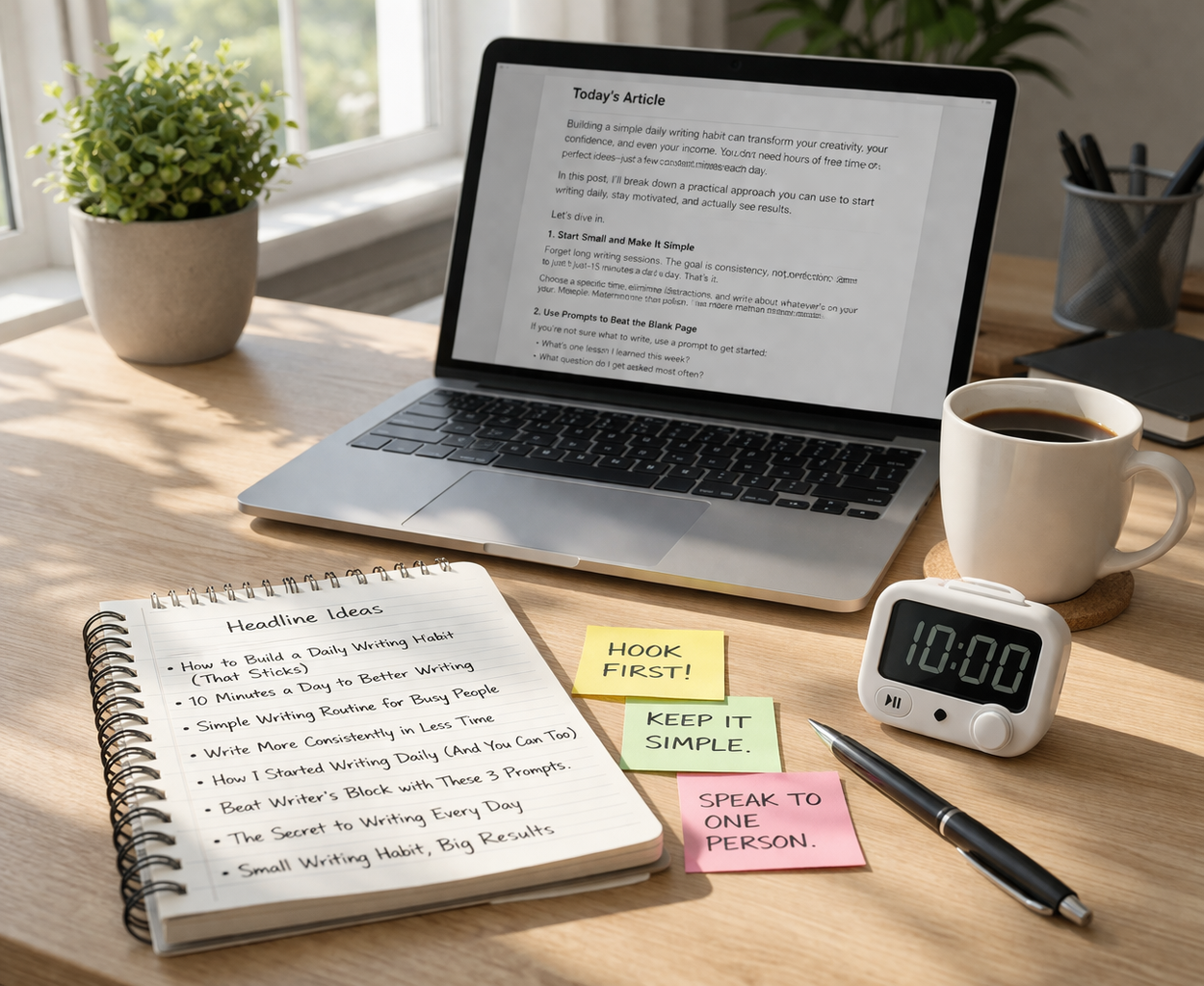
8 Copywriting Exercises for Beginners That Build Real Skill
Takes Just 10 Minutes a Day

Introduction: Why Tiny Daily Practice Beats Grand Dramatic Plans
If you are new to this whole writing-for-results thing, copywriting can feel a bit like being handed a frying pan and told to make a five-star meal with no recipe. On one hand, everyone says it is one of the most useful skills you can learn. On the other hand, most advice makes it sound like you need endless courses, a giant swipe file, and three extra hours a day.
Thankfully, that is nonsense.
In reality, the fastest way to improve is usually the simplest. A short, focused routine works better than waiting for the perfect mood, the perfect notebook, or the perfect iced coffee. In fact, ten minutes of daily effort can do more for your progress than one giant study session every two weeks. That is why copywriting exercises for beginners work so well. They are small enough to do consistently, yet powerful enough to sharpen your thinking, your clarity, and your ability to hold attention.
Even better, these habits fit into real life. You can do them before work, during lunch, or while pretending you are taking a very serious productivity break. Meanwhile, every little session adds another brick to your skill set.
So, if you have been wondering how to practice copywriting without turning your calendar into a battlefield, this guide will help. You will find practical drills, fresh examples, extra tips, and a simple way to make progress without frying your brain.
What Makes Copywriting Exercises for Beginners So Effective
he big reason copywriting exercises for beginners work is that they train specific skills in short bursts. Rather than trying to master everything at once, you focus on one small move at a time. That makes progress easier to notice and, just as importantly, easier to repeat.
For example, one exercise may improve your headlines. Another may help you simplify clunky sentences. A different one may teach you how to write stronger hooks. Piece by piece, your writing becomes clearer and more persuasive. Eventually, you stop guessing and start noticing patterns.
In addition, short exercises lower resistance. A full-blown writing session can feel heavy. Ten minutes, however, feels doable. That matters because consistency is the secret sauce. Daily copywriting exercises build momentum, and momentum is what helps beginners stick with the process long enough to improve.
There is also another benefit people do not talk about enough. Practice reduces fear. When you write often, you stop treating every sentence like a final exam. Instead, you get more playful, more curious, and more willing to test ideas. That is where growth happens.
So, if your goal is to learn how to improve copywriting without making life harder, daily drills are a smart move. They are practical, low-pressure, and surprisingly effective.
How Copywriting Exercises for Beginners Build the Core Skills
Good copy is not magic. It is mostly a stack of learnable skills working together. First, you need clarity. If people cannot understand your message quickly, they are gone. Next, you need attention. That is where hooks and headlines come in. After that, you need flow, emotion, relevance, and structure.
The beauty of copywriting exercises for beginners is that each drill can target one of those pieces. Rewriting headlines trains attention. Tightening sentences improves clarity. Breaking down successful copy teaches structure. Writing micro stories adds personality and emotion. Over time, the puzzle starts to come together.
Meanwhile, short practice sessions help you develop speed. At first, writing one decent headline might take forever. Later, you can come up with ten before your tea gets cold. That speed matters because it gives you options. Usually, the first idea is not the strongest. The better idea often shows up after a few awkward attempts.
In other words, daily practice gives you more than improvement. It gives you flexibility. You learn how to adapt your message, test angles, and say the same thing in a sharper way. That is incredibly useful whether you are writing emails, posts, captions, landing pages, or anything else tied to Internet Profit Success.
Copywriting Exercises for Beginners:
Rewrite Strong Headlines Every Day
One of the easiest ways to train your copy brain is by rewriting headlines you see online. This works because strong headlines already contain useful ingredients such as curiosity, clarity, emotion, and specificity. Instead of admiring them like a fancy cake in a bakery window, you pull them apart and bake your own versions.
Start by collecting one headline a day from an ad, email, article, or social post. Then rewrite it three to five different ways. Change the angle. Shorten the wording. Make it more emotional. Make it more direct.
Suppose you find a headline that says, Stop Struggling With Content. You could rewrite it as Make Content Feel Easier Starting Today. You could also try Why Content Feels So Hard and How to Fix It. Or maybe, The Simple Habit That Makes Writing Less Painful.
This exercise teaches flexibility. In addition, it helps you notice how small word changes create different reactions. For example, struggle feels heavier than stuck, while simple feels more approachable than effective. If you want extra headline fuel, studying power words for copywriting can give you even more angles to test.
As daily copywriting exercises go, this one is gold because it is fast and endlessly repeatable. You will also build a personal swipe file without much effort. Over time, you begin to see headline patterns everywhere, which is oddly satisfying and slightly dangerous because you may start judging billboards in public.
Copywriting Exercises for Beginners:
Turn Messy Sentences Into Clear Ones
If headlines grab attention, clear sentences keep it. Unfortunately, beginners often write like they are trying to impress a very strict English teacher from the 1800s. The result is usually long, tangled wording that sounds clever but feels heavy. It also helps to review the content mistakes to avoid before your audience tunes out, because weak clarity usually shows up before readers disappear.
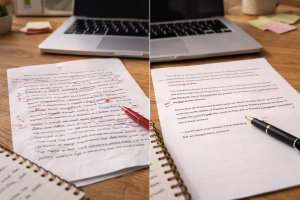
That is why one of the most helpful copywriting exercises for beginners is sentence cleanup. Take a paragraph you wrote and make every sentence shorter, simpler, and easier to read. Your goal is not to sound fancy. Your goal is to sound human.
For instance, you might start with this: One of the main reasons many beginners experience disappointing results is because they tend to overcomplicate the process unnecessarily.
A cleaner version would be: Beginners struggle because they make things too complicated.
Same idea. Less fluff. More punch.
As you do this, watch for filler phrases, weak verbs, and repeated ideas. Swap vague wording for concrete words. Cut anything that does not earn its spot. Also, read your sentences out loud. If you run out of breath halfway through, the sentence is probably trying to do too much.
When people ask how to improve copywriting, this is one of the best answers. Better clarity usually leads to better engagement. Besides, clean writing respects the reader. It makes your message easier to follow, which is always a good look.
Copywriting Exercises for Beginners:
Break Down Copy That Actually Works
Reading good copy is helpful. Studying why it works is even better.
This is where analysis comes in. Find a strong email, ad, landing page, or post, and ask simple questions. What is the hook? How does it open? What problem does it bring up? What emotional tone does it use? Where does it create curiosity? How does it move the reader forward?
At first, keep it simple. You are not writing a college essay. You are just learning to spot patterns. For example, maybe an email works because it starts with a frustrating everyday moment. Perhaps a sales page keeps pulling you along because each section leads naturally into the next. Or maybe a post gets attention because it promises a quick win right away.
These observations matter because they train your instincts. Soon, you stop seeing copy as random words on a screen. Instead, you start seeing structure. You notice the parts doing the heavy lifting.
Among daily copywriting exercises, this one sharpens your thinking fast. It also helps you steal the right things, by which I mean ideas, frameworks, and patterns, not actual sentences. That would be weird and lazy.
Eventually, when you sit down to write, you will have more models in your head. That makes it much easier to know how to practice copywriting with purpose instead of just staring at a blank page and hoping a miracle shows up.

Copywriting Exercises for Beginners:
Write Hooks That Stop the Scroll
Hooks are the gatekeepers of attention. If your first line is weak, people vanish faster than biscuits at a family gathering. That is why hook practice deserves a permanent place in your routine. That same skill matters when you want to get people to read your posts in a crowded feed, because most readers decide in a second or two whether to keep going.
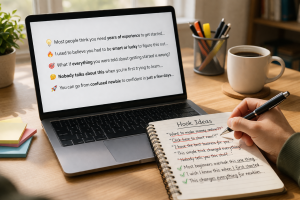
A smart exercise is to write five to ten opening lines every day based on real audience problems, frustrations, dreams, or mistakes. Focus on being specific. A vague hook is easy to ignore. A sharp one makes people lean in.
Here are a few examples:
If your posts get ignored, this might be why.
Most beginners ruin their writing before the second sentence.
Nobody talks about this copy mistake, but it is everywhere.
The fastest way to sound clearer is not what you think.
Notice how each one creates a little tension. That tension is useful because it pulls the reader into the next line. If you want a ready-made swipe file, keep these social media hooks that stop the scroll fast nearby during your practice sessions.
In addition, try different hook styles. Use a question. Make a bold statement. Point out a mistake. Offer a surprising benefit. Share a mini confession. The more angles you test, the better your instincts become.
When people search for copywriting exercises for beginners, this should be near the top of the list. Strong hooks improve emails, blog intros, ads, captions, and even video scripts. In other words, it is one skill that pays off almost everywhere.
Copywriting Exercises for Beginners:
Summarize Big Ideas in One Sentence
Another underrated exercise is summarizing something complicated in one simple sentence. This sounds easy until you try it. Suddenly, your brain starts acting like a confused squirrel.
Still, this drill is incredibly useful. It teaches you how to find the main point and express it clearly. That is essential in copy because people do not want a maze. They want a message they can grasp quickly.
Take a long article, podcast lesson, video takeaway, or rambling note you wrote. Now boil it down into one sentence that feels clear, useful, and memorable.
For example, a long explanation about consistency, testing, and patience could become this: The people who improve fastest are the ones who keep showing up.
That sentence is easier to understand, easier to remember, and easier to build on.
As daily copywriting exercises go, this one improves clarity, focus, and rhythm all at once. It also helps you write better subject lines, calls to action, bullets, and headline ideas because those all depend on saying a lot with very few words.
On the other hand, do not worry if your first attempts feel clunky. That is normal. The value is in the struggle. Every time you simplify a messy idea, you train yourself to communicate better, which is a huge part of how to improve copywriting over time.
Copywriting Exercises for Beginners:
Study Ads Without Copying Them
Ads can teach you a lot when you study them the right way. Instead of rolling your eyes and muttering, Oh look, another ad, use them as learning material. Good ads reveal how writers get attention, frame problems, position solutions, and guide readers forward.
Choose one ad a day and break it into pieces. Look at the opening line, the problem being highlighted, the tone, the promise, and the structure. Ask yourself what the writer wants the reader to feel at each stage.
For example, an ad might begin with a frustration, then introduce a simpler path, then stack benefits, and finally close with a gentle next step. Another ad may rely heavily on curiosity, while a different one may lean on proof or storytelling.
This matters because ads are usually built to persuade quickly. That makes them excellent study tools for beginners. Meanwhile, you start collecting real examples of what effective messaging looks like in action.
Just remember one important thing. Study the strategy, not the exact phrasing. You are learning how to practice copywriting, not how to become a copy-and-paste goblin.
If you keep doing this, you will develop a better sense of pacing, tone, and structure. And honestly, once you start seeing how ads are built, the whole thing becomes a bit like watching a magician reveal the trick.
Copywriting Exercises for Beginners:
Use AI Prompts as a Practice Partner
Used properly, AI can be a surprisingly helpful practice buddy. It is not a replacement for thinking, and it definitely should not do all the work while you stare heroically into the distance. However, it can speed up experimentation and help you compare different approaches.
Try prompts like these:
Write ten hooks for beginners struggling with content. Rewrite this paragraph to make it clearer and more conversational. Give me five headline angles based on this problem. Turn this idea into three stronger opening lines.
Once you get the responses, do not stop there. Compare them. Ask yourself what sounds stronger and why. Then rewrite the best version in your own words. That final step matters because the real skill comes from evaluation, not from pressing buttons like a sleepy raccoon.
This is one of the more modern daily copywriting exercises, and it can be useful when you feel stuck. In addition, it exposes you to more examples quickly, which helps you recognize patterns. Over time, you begin to notice what makes certain wording stronger, punchier, or more natural.
For beginners, this can reduce the fear of the blank page. Still, your own judgment is the real engine. AI can suggest. You decide. That mindset will keep your writing sharp and original, which is especially important if your goal includes growth, trust, and long-term Internet Profit Success.
Copywriting Exercises for Beginners:
Write One Micro Story a Day
Facts can inform, but stories stick. That is why storytelling belongs in your routine, even if you are not trying to write dramatic novels about a mysterious umbrella and a train station at midnight.
A micro story is simply a small real-life moment with a lesson. Maybe you almost skipped a task and learned something from it. Perhaps you noticed a mistake while shopping. Maybe a short conversation changed your thinking. The story does not need fireworks. It just needs a relatable moment and a clear takeaway. That is also a smart way to stand out on social media with a small audience, because personality gives people a reason to remember you.
For example, you could write about putting off a post because it did not feel perfect, then realizing that imperfect but published beats perfect and invisible. That tiny story can lead naturally into a lesson about consistency and communication.
This exercise helps beginners sound more human. It also adds emotional texture to your writing. Readers connect with moments, not just information. In addition, stories create variety, which makes your copy more engaging.
If you are wondering how to practice copywriting without making it dry, this is a great answer. Micro stories build personality, trust, and relatability. Over time, they also give you a bank of real examples you can use in emails, posts, blog intros, and captions.
Besides, they make the practice more fun, which is no small thing.

A Simple 10-Minute Routine for Daily Copywriting Exercises
Now that you have a menu of ideas, the easiest way to stay consistent is to use a short routine. Otherwise, you may spend half your practice time deciding what to practice, which is not ideal unless indecision is your favorite hobby.
Here is a simple structure:
Spend two minutes collecting a headline, ad, or piece of writing to study.
Use four minutes on one focused exercise, such as rewriting headlines or tightening sentences.
Then spend three minutes writing hooks, summaries, or a micro story.
Finish with one minute reviewing what felt stronger and why.
That is it. Nothing fancy. No dramatic montage required. If you want that habit to last, borrow a few ideas from content creation without burnout so your schedule stays light enough to repeat.
You can also rotate the focus by day. For instance, Monday can be headlines, Tuesday can be sentence clarity, Wednesday can be analysis, Thursday can be hooks, and Friday can be storytelling. Meanwhile, the weekend can be for review or catch-up.
This type of routine works because it removes friction. You know what to do, you know how long it takes, and you can actually stick with it. Most importantly, daily copywriting exercises only pay off when they are done regularly. And when life gets hectic, a few ways to create content faster can help you protect the habit without cutting corners.
So, keep it light. Keep it practical. And keep showing up, even when your brain insists that alphabetizing your spice rack is somehow more urgent.

Common Mistakes Beginners Make While Doing Copywriting Exercises
Practice helps, but only if you avoid a few common traps.
First, many beginners try to do too much at once. They rewrite headlines, study five ads, draft a full post, and attempt a complete sales page in one sitting. Naturally, they end up tired and confused. Smaller sessions work better because they let you focus deeply on one skill.
Second, some people practice without feedback. Even a quick self-review matters. Ask what improved, what felt weak, and what you would change next time. Otherwise, you may keep repeating the same habits.
Third, beginners often confuse clever writing with effective writing. Fancy wording may sound impressive, but clear writing usually performs better. So, whenever you feel tempted to write like a poet trapped in a boardroom, simplify instead.
Another mistake is reading a lot without writing much. Analysis is useful, but output is where the real growth happens. You learn more by writing ten hooks than by reading fifty examples passively.
Finally, many people quit too early. They expect dramatic progress in a week. However, writing improves like fitness. The results show up through repetition. The good news is that copywriting exercises for beginners can produce noticeable gains fairly quickly if you stick with them. Not magic, just momentum. A lot of those bad habits are reinforced by social media myths beginners need to stop believing, especially the idea that more noise automatically means better content.
How to Practice Copywriting When You Feel Unmotivated
Not every day feels inspiring. Some days your brain is sharp. Other days it feels like a soggy sock. That is normal. The trick is to make practice easy enough that you can still do it on low-energy days. On low-energy days, having a system for how to come up with content ideas when you feel stuck can save the session before overthinking takes over.
Lower the bar, but keep the habit. Instead of writing ten hooks, write three. Rather than analyzing a full landing page, study one headline and one call to action. A tiny win keeps the streak alive, and that matters more than one heroic session followed by three days of avoiding your laptop.
In addition, use prompts that remove decision fatigue. Keep a short list of go-to exercises ready. That way, you are not asking yourself what to do every time. You just begin.
Another useful tactic is to attach practice to something you already do. For example, write five minutes before lunch, after coffee, or right before you check social media. That creates a routine anchor.
Meanwhile, give yourself permission to write badly. Practice is not performance. It is training. Some days the work will feel strong. On other days it will feel lumpy and weird. Both still count.
If your goal is to learn how to improve copywriting, consistency beats mood almost every time. Show up tired if needed. Show up grumpy if necessary. Just keep showing up.
Extra Helpful Tips to Make Copywriting Exercises for Beginners Work Faster
There are a few bonus tactics that can speed up your progress.
First, keep a swipe file. Save strong headlines, hooks, story openings, calls to action, and sentence structures you like. Not to copy, but to study. This gives you a personal idea bank for future practice.
Second, read your writing aloud. Awkward wording often reveals itself instantly when spoken. If it sounds stiff, it probably needs work.
Third, track your best examples. Each week, save one headline, one hook, one sentence rewrite, and one short story you feel good about. Over time, you will see proof that you are improving, which helps when motivation dips.
Next, focus on real audience problems. Practice becomes much easier when you write about frustrations, goals, doubts, and desires people actually have. Specificity creates stronger copy.
Also, do not neglect rhythm. Short sentences create punch. Longer ones add flow. Mixing them keeps your writing lively and easier to read.
Finally, remember that the goal is not perfect copy. The goal is stronger copy. That small mindset shift changes everything. It keeps you moving, testing, and improving instead of freezing up over every word choice.
And yes, that matters a lot if you want clearer content, more engagement, and better long-term results tied to Internet Profit Success.
Conclusion: Small Daily Practice Creates Big Long-Term Gains
Copywriting does not improve through wishful thinking, endless bookmarking, or telling yourself you will start properly on Monday. It improves through action. More specifically, it improves through focused, repeatable action that fits into real life.
That is why copywriting exercises for beginners are so powerful. They help you practice headlines, clarity, hooks, structure, summaries, analysis, AI-assisted rewrites, and storytelling without needing giant blocks of time. In addition, they reduce overwhelm because you are only working on one small skill at a time.
So, if you have been wondering how to practice copywriting in a way that actually sticks, start small and stay consistent. Rewrite one headline. Tighten one paragraph. Study one ad. Write five hooks. Tell one micro story. Then do it again tomorrow.
Eventually, your writing gets sharper. Your ideas get clearer. Your confidence grows. Better still, the process starts feeling normal instead of intimidating.
That is the real win. Not perfection. Not instant genius. Just steady progress that compounds.
And honestly, ten minutes a day is a pretty fair trade for stronger writing, better communication, and a real path toward the kind of skills that support long-term Internet Profit Success.
