
Scroll Stopping Hooks for Engagement
Every Creator Should Know These
INTRODUCTION TO SCROLL STOPPING HOOKS FOR ENGAGEMENT
If there’s one sentence that decides whether someone reads your whole social post or keeps scrolling, it’s the first line, the part we call the scroll stopping hook for engagement. These hooks are the gateway to attention in a world where people swipe faster than ever. On platforms like Instagram, LinkedIn and TikTok, your audience gives you just seconds, sometimes just a few words, to make them stop and actually engage. That’s where knowing how to write strong, scroll stopping hooks for engagement makes all the difference.
A scroll stopping hook for engagement isn’t just a catchy opener. It’s a strategic tool designed to grab attention, spark curiosity, and lead your reader or viewer into the rest of your message. When you master these hooks, you can boost visibility, grow interaction, and enhance performance, whether you’re writing captions, blog intros, or videos. Meanwhile, for those working toward Internet Profit Success, hooks are often the first step that determines whether your content gets traction or gets ignored entirely.
Today, we’ll unpack what scroll stopping hooks are, how they work psychologically, and provide dozens of hook ideas you can use across platforms. We’ll also share examples, actionable steps, and variations you can test. Let’s dive into why this matters, how to use them, and how to apply them toward engagement and your larger content goals.
WHAT IS A SCROLL STOPPING HOOK FOR ENGAGEMENT AND WHY IT MATTERS
At its core, a scroll stopping hook for engagement is the first line or idea in your content that immediately captures attention and makes someone pause. It’s the bait that pulls them in just long enough to read the next sentence, watch the next clip, or click through to your full post.
Hooks can come in many forms, questions, statements, micro-stories, statistics, challenges, and more.

One big reason hooks matter is because attention spans online are shrinking. Some research suggests social media users decide whether they’re interested in the first 1–3 seconds or first few words. If your opening isn’t compelling, everything else you wrote might as well not exist.
Take a look at 14 Free Marketing Tools Every Online Marketer Should Be Using Today
Scroll stopping hooks for engagement are critical for:
• Drawing attention in oversaturated feeds
• Boosting social media engagement signals like likes, replies, and shares
• Increasing content visibility through algorithmic reach
• Turning casual scrollers into engaged audiences
In addition, using scroll stopping hooks for engagement consistently across your content strategy boosts your overall brand recognition. Whether your goal is to teach, entertain, or convert, hooks are your first and sometimes most important line of defense against being ignored.
UNDERSTANDING THE PSYCHOLOGY BEHIND SCROLL STOPPING HOOKS FOR ENGAGEMENT
Why do certain openings work and others don’t? A scroll stopping hook for engagement works because it taps into basic human psychology, especially curiosity and emotional resonance. People scroll as a fast, instinctive action. They’re in what psychologists call a fast-thinking mode: quick, emotional, and automatic. The right hook interrupts that quick pattern and invites them to engage further.
A few psychological triggers that make hooks effective include:
Curiosity
People naturally seek to fill gaps in information. If your hook hints at something intriguing but incomplete, they’ll want to know more. You'll find more information in How to Build a Profitable Funnel: A Complete Beginner’s Guide// [17JAN]
Emotion
Content that makes readers feel something, surprise, amusement, relief, even discomfort, creates a stronger connection and motivates engagement.
Social proof and belonging
When a hook suggests that others are involved or that data backs up a claim, viewers become more invested.
Relevance
Directly addressing someone’s situation, identity, or pain point makes them feel seen and more likely to interact.
Understanding these triggers helps you write scroll stopping hooks for engagement that do more than just attract attention, they hold it long enough to drive action.

HOW TO WRITE SCROLL STOPPING HOOKS FOR ENGAGEMENT
Writing effective scroll stopping hooks for engagement takes both creativity and strategy. Below are proven methods you can use immediately, with clear examples and action steps.
1. ASK A SURPRISING QUESTION THAT REVEALS A COMMON BELIEF
Questions work because they invite an internal response. When a question challenges something people assume, it often stops the scroll.
Action Steps:
• List common beliefs in your niche.
• Turn the clearest one into a short, provocative question.
• Follow with a promise of value in the next line.
Example: “Are you still convinced you need a massive budget to get engagement?”
This flips a common assumption and primes the reader for practical tips.
2. START WITH A SPECIFIC NUMBER OR RESULT
Numbers promise clarity. They give people something concrete to latch onto.
Action Steps:
• Pick a realistic result you can explain or teach.
• Use exact figures, avoid vague terms like “many” or “a lot.”
Example: “7 hook ideas that doubled my engagement in 14 days.”
3. OPEN WITH A SHORT, RELATABLE MINI‑STORY
Stories build instant rapport because they feel human. A quick snippet that highlights a struggle or discovery draws emotional interest.
Action Steps:
• Think of a moment that captures a problem and its resolution.
• Keep it very short, one or two sentences that suggest a lesson is coming.
Example: “Last week, I posted ten times with zero engagement, then I changed one thing.”
4. USE BEFORE/AFTER OR CONTRAST HOOKS
Contrasts are powerful because they show transformation. People want to know how to go from one state to a better one.
Action Steps:
• Identify a typical “before” state your audience knows well.
• Show a compelling “after” that implies improvement.
Example: “From invisible posts to chats in minutes, here’s the shift.”
5. CALL OUT A COMMON MISTAKE
Identifying a mistake your audience likely makes can make them stop and check if the same thing applies to them. More help? 11 Online Marketing Tips for Beginners That Saved Me Weeks of Frustration
Action Steps:
• List beginner mistakes in your topic area.
• Pick the most impactful one and make it your hook.
Example: “Most creators post randomly and wonder why no one engages,” so these tips will help you overcome this. Stop Sabotaging Your Growth: Common Mistakes New Internet Marketers Make
6. BEGIN WITH A COMMAND THAT OFFERS IMMEDIATE VALUE
Commands are direct and action‑oriented. They tell the reader exactly what to do, and they work especially well when tied to quick wins.
Action Steps:
• Choose one small tactic your reader can apply instantly.
• Phrase it as an imperative verb followed by a benefit.
Example: “Fix your hook in 60 seconds with these simple edits.”
7. LEAD WITH A SURPRISING FACT
Surprising, credible snippets make people pause because they feel like a revelation. Stories, commands, and numbers are all effective because they anchor attention.
Action Steps:
• Find a surprising piece of data or insight.
• Structure it so the benefit or takeaway is clear.
Example: “Stopping daily posts increased my engagement, here’s why.”
8. USE A FILL‑IN‑THE‑BLANK STYLE
Interactive hooks make readers fill in something mentally, which increases attention.
Action Steps:
• Craft a sentence with a blank focusing on a desire or pain point.
• Provide the answer or method in the next lines.
Example: “The one thing every new creator forgets is _____, and here’s how to fix it.”
9. START WITH A RELATABLE PAIN POINT
Hooks that start with a problem signal empathy and relevance. They make readers feel understood.
Action Steps:
• Phrase a pain point as the opener.
• Quickly follow it with relief or a hint at the solution.
Example: “Tired of posting and getting nothing?”
10. OPEN WITH A SIMPLE PROMISE OF A QUICK WIN
Everyone loves immediate results. If a hook promises a quick win, engagement is more likely.
Action Steps:
• Identify a tiny result that’s genuinely achievable.
• Keep the promise simple and credible.
Example: “Get one extra reply on your next post with this trick.”
These are just a handful of ways to write scroll stopping hooks for engagement. Each comes from proven principles of attention, psychology, and reader behavior. The key is testing variations and paying attention to what resonates with your audience. This will increase your traffic fast.
EXAMPLES OF SCROLL STOPPING HOOKS FOR ENGAGEMENT YOU CAN USE NOW
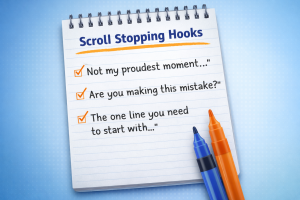
Here are sample hooks using the ideas above:
• “What if everything you think about engagement is backwards?”
• “3 surprising hook tweaks that boosted my replies by 50%.”
• “I posted 5 times with no response, until I learned this.”
• “Struggling with engagement? Try this one switch.”
• “Stop using generic captions, do this instead.”
• “Here’s the mistake costing you hundreds of interactions.”
• “Try this quick phrase and watch replies soar.”
• “Most creators ignore this simple engagement hack.”
• “How I turned boring captions into conversations.”
• “The one line every post needs for better engagement.”
These hooks are crafted to be attention‑grabbing, curiosity‑driven, and directly tied to engagement outcomes, which is exactly what scroll stopping hooks for engagement are meant to do. Whether your goal is to grow your audience, spark community reaction, or move closer to your Internet Profit Success check out the Babylon Wealth Principles.
HOW TO IMPLEMENT SCROLL STOPPING HOOKS FOR ENGAGEMENT IN YOUR CONTENT STRATEGY
Writing great hooks is step one, using them consistently is where the magic happens. Here’s how to implement these hooks across your content:
Build a swipe file. Save hooks that perform well so you can reuse and adapt them.
Test variations. Try different hook types for the same content to learn what resonates.
Pair hooks with strong value. A hook without follow‑through can feel like clickbait; always deliver on the promise. Check out TikTok Content Ideas for Affiliates Who Hate the Camera (and Still Win Big)
Use hooks across formats. Hooks aren’t just for captions, use them in blog intros, email subject lines, video intros, and ad copy.
Track engagement metrics. Pay attention to likes, replies, watch time, and shares to gauge which hooks work best.
Remember, even the best scroll stopping hooks for engagement are only as good as the content that follows. Hooks get people to start reading, what you provide next keeps them there.
CONCLUSION: MASTERING SCROLL STOPPING HOOKS FOR ENGAGEMENT
Hooks are the gateway to attention, and attention is the currency of the online world. Whether your goal is to grow your audience, spark community reaction, or move closer to your Internet Profit Success, mastering scroll stopping hooks for engagement should be at the top of your skill list. Learn more at Rich Dad Poor Dad Internet Marketing Lessons: 11 Wealth Secrets

From surprising questions to quick‑win commands, there’s a hook type for every creator and every niche. Experiment with different styles, listen to your audience, and don’t be afraid to test bold variations. Over time, you’ll develop a sense of what stops the scroll and what doesn’t.
And remember, the hook is just the start. The real engagement comes when you follow through with content that informs, entertains, helps, or inspires your audience. With great hooks and great value behind them, you’ll keep readers reading, watchers watching, and engagers engaging.
For more strategies and beginner success frameworks, check out Online Business Success Strategies: A Fun & Practical Guide to Internet Profit Success
