

7 Sales Funnels for Beginners You Can Build This Weekend
These Are Shockingly Simple and Skip The Tech Mess

Introduction
Funnels have a weird reputation. Somehow, the moment people hear the word funnel, they imagine twelve apps, seventeen automations, a spreadsheet that looks like a NASA launch checklist, and a mild identity crisis by Sunday afternoon. In reality, sales funnels for beginners do not need to be fancy to be effective. In fact, the opposite is usually true.
The simpler the path, the easier it is to build, understand, test, and improve. A good funnel is not there to impress your cousin who suddenly became a “growth hacker” last Tuesday. It is there to help real people take one logical next step. A sales funnel is simply a step by step journey that moves someone from discovering you to trusting you to taking action.
That is why simple sales funnels are such a smart place to start. Instead of trying to build a giant machine right away, you create one clear path with one clear goal. Maybe that goal is collecting email subscribers. Maybe it is booking a call. Maybe it is getting someone to buy a small starter product.
Whatever the outcome, the best sales funnels for beginners keep the moving parts light and the message clear. Meanwhile, they still do the important work of warming up leads, showing value, and guiding people toward a solution that actually helps.
Make Them Better
Better still, you can build many sales funnels for beginners in a single weekend. No, that is not internet magic dust. It is simply the result of choosing a funnel structure that matches your current skill level. You do not need a giant audience, a film studio, or a dramatic voice that says things like “unlock hidden wealth secrets.” You need a useful idea, a clear message, and a basic setup that works. That is where this guide comes in.
Below, you will find seven sales funnels for beginners that are practical, realistic, and beginner friendly. In addition, you will see detailed examples, helpful tips, and simple ways to choose the right funnel for your situation. So whether you are building your first lead magnet funnel, testing low ticket products, or just trying to avoid a tech meltdown before lunch, this guide will help you create something you can actually launch.

Why Sales Funnels for Beginners Work Better When They Stay Simple
One of the biggest mistakes beginners make is assuming more steps automatically mean more results. However, more steps usually mean more confusion. And when your funnel is confusing, people leave. They do not leave because your idea is bad. They leave because the path feels messy, unclear, or like too much work.
That is why sales funnels for beginners work best when each step has one job. A landing page should get the opt in. A thank you page should guide the next action. An email sequence should build trust and point people forward. Every piece needs a purpose, not a costume change.
Simple sales funnels also help you learn faster. If you build a funnel with ten steps and something goes wrong, good luck playing detective. On the other hand, if you build a funnel with three or four clear pieces, you can quickly spot where people are dropping off. Maybe your landing page promise is too vague. Maybe your emails are fine, but your offer is mismatched.
Maybe your call to action sounds like it was written by a sleepy robot. Because the system is simpler, the fix becomes simpler too. That is one reason so many current beginner focused funnel guides recommend starting with a lead funnel, then layering in a low ticket offer or core offer later.
What Sales Funnels for Beginners Need Before You Build Anything
Before you start building sales funnels for beginners, get clear on who you want to help, because a few smart ideal customer profile questions can save you from building a funnel for a vague blob of “everyone. you need three things.
First, you need a specific audience. If your topic still feels too broad, this quick guide on How to stand out in a crowded niche will help you narrow your angle before you build anything. Not “everyone who wants success,” because that is not an audience. That is a blurry cloud. Instead, aim for a group with a clear problem, such as new affiliate marketers who need content ideas, beginner coaches who need more calls, or service providers who need a simple client-getting system.
Second, you need one promise. If your promise still sounds fuzzy, tightening your clear marketing message first will make every page, email, and call to action in the funnel much easier to write. This matters more than people realize. Your funnel should answer one basic question fast. What helpful result does this person get by opting in, joining, booking, or buying?
If the answer is fuzzy, your conversions will be fuzzy too. People do not take action when they feel confused. They take action when the next step feels useful and obvious.
Third, you need one main action. This is where beginners often wander into the weeds. Do you want the visitor to subscribe, buy, book, or reply? Pick one. Then make the rest of the funnel support that action. The truth is, most sales funnel examples that work well are not trying to do twenty things at once. They are focused. And focused funnels are much easier to finish, which is important because the internet is full of half built masterpieces no one ever launched.
Sales Funnels for Beginners 1: The Simple Lead Magnet Funnel

If there is a universal starting point for sales funnels for beginners, it is the lead magnet funnel. This is the classic setup where you offer a useful free resource in exchange for an email address, then follow up with a short nurture sequence. Once someone grabs your free resource, a short email nurture sequence keeps the relationship moving instead of letting fresh leads cool off in silence. It works because it asks for a small commitment first. Nobody has to marry your brand on the first date. They just need enough interest to say, “Sure, I’ll take that checklist.”
A lead magnet funnel usually works best when the resource solves one small, immediate problem. Think checklists, templates, swipe files, mini guides, short video lessons, or planners. In other words, avoid creating a 97 page encyclopedia when your audience really wants a shortcut they can use today.
A lead magnet funnel is most effective when the thing you offer feels relevant, specific, and fast to consume. That basic structure is still a common top of funnel approach because it introduces your brand, captures contact information, and creates a natural opening for follow up.
For example, let’s say your audience is brand new content creators. You could offer a resource called 25 Post Starters for Days When Your Brain Goes on Vacation. The landing page explains the benefit, the opt in form collects the email, and the thank you page invites them to watch a quick training or check their inbox.
Then your follow up emails teach a few content basics, share a small win, and naturally introduce a starter product or service. Suddenly, you are not just handing out a freebie. You are building a relationship.
To make this funnel stronger, match the lead magnet to the next offer. If your paid product is about email writing, your lead magnet should not be a random Instagram calendar just because it looks cute. Relevance matters. In addition, keep the landing page clean, write a benefit driven headline, and avoid asking for too much information.
Name and email will usually do the job. This is one of the best sales funnels for beginners because it is easy to build, easy to test, and easy to improve.
Sales Funnels for Beginners 2: The Low Ticket Tripwire Funnel
Once your lead magnet funnel is bringing people in, the next natural step is often a low ticket offer, sometimes called a tripwire funnel. This is where you present a small, valuable paid product immediately after the opt in or shortly after in email.
The goal is not to make a life changing fortune from a tiny product. The goal is to turn subscribers into buyers and build momentum. That first purchase changes the relationship.
A low ticket product works because it lowers resistance. Instead of asking a new subscriber to jump straight into a high commitment purchase, you offer something quick, affordable, and useful.
Current marketing guides still frame this as the bridge between free content and larger offers, especially for creators and educators. These products are often positioned in the lower price range and used to qualify more serious buyers while giving them a fast win.
Imagine someone downloads your free guide about writing better hooks. Right after that, they see a page offering a Hook Writing Toolkit with 100 plug and play examples, a caption formula sheet, and a mini tutorial. It is inexpensive, easy to understand, and clearly related to what they already wanted. That is the magic. It does not feel random. It feels like the next useful step.
Now, here is the important part. Your low ticket product should actually be good. Shocking advice, I know. But too many people treat these offers like cheap filler. Instead, make it practical, easy to consume, and tied to one result.
A swipe file, mini course, script bundle, workbook, checklist pack, or template set can all work well. If it saves time, reduces confusion, or gives a quick win, you are on the right track. Among the best sales funnel examples, this type of funnel often performs well because it combines low friction with strong relevance.
Sales Funnels for Beginners 3: The Mini Workshop Funnel

Some sales funnels for beginners work best when people need to see your thought process before they buy. That is where the mini workshop funnel shines. Instead of offering a static freebie, you invite people to register for a short workshop, training, or live session.
If you want the workshop to feel helpful instead of pitchy, a few storytelling in marketing principles can make the teaching smoother and the offer transition much more natural. The topic should promise a useful result in a short amount of time. Think practical, not philosophical. People want help, not a dramatic TED Talk filmed in your kitchen.
A mini workshop can be pre recorded or live. Both options work. If you are nervous on camera, remember that “nervous but helpful” beats “perfect but never published” every single time. The key is to teach something actionable, build trust, and then invite people to take the next step.
For example, a workshop called How to Create a Week of Content in One Hour could teach a simple planning framework, show a few examples, and then introduce a template pack or coaching session at the end.
This funnel works especially well for small audiences because it compresses trust. Instead of hoping someone reads five emails and slowly becomes interested, you give them value in a focused session. In addition, workshops create a reason for people to show up now rather than “sometime later,” which is where many good intentions go to quietly disappear.
Use a registration page, a reminder email sequence, the workshop itself, and then a replay email that leads to your offer. Clean, useful, and surprisingly doable.
If you choose this funnel, keep the training tight. Twenty to thirty minutes is often enough. Also, focus on one transformation, not a brain dump. People should leave thinking, “That was helpful, and I can imagine learning more from this person.” That is the whole game.
Sales Funnels for Beginners 4: The PDF to Call Funnel
If you sell services, consulting, or coaching, one of the smartest sales funnels for beginners is the PDF to call funnel. In this setup, you offer a practical downloadable guide, then use the follow up sequence to invite qualified people to book a call.
This works because the guide helps pre educate the lead before the conversation. So by the time someone books, they already understand the problem, want the outcome, and have a better sense of how you think.
For example, suppose you help beginner business owners improve their messaging. You could offer a PDF called 7 Messaging Mistakes That Make Good Offers Sound Confusing. Inside the guide, you explain the common mistakes, show quick fixes, and mention that readers can book a short clarity call if they want personalized feedback. Then your email follow up reinforces the same points, shares a simple case example, and invites the reader to schedule a conversation.
This is one of the most practical sales funnels for beginners because it does not require a giant course library or an elaborate backend. This funnel works even better when your guide and follow-up emails quietly build trust, which is why learning how to build credibility online fast pays off before the call ever happens.
It simply uses useful content to start better conversations. At the same time, it qualifies leads. Someone who downloads a guide about messaging and then books a call is far more likely to be relevant than someone who just randomly appears in your inbox saying, “Hey, do you do stuff?”
To make this work well, your PDF should be highly specific. Avoid broad titles like The Ultimate Guide to Marketing. That sounds like homework. Instead, solve one painful problem. In addition, make the call invitation feel natural, not pushy. You are offering the next helpful step, not cornering people in a digital alleyway.
Sales Funnels for Beginners 5: The Value Email Series Funnel
Not every funnel needs a downloadable freebie. In fact, some sales funnels for beginners work beautifully with nothing more than a well planned email sequence. In a value email series funnel, someone signs up to receive a short lesson series delivered over several days. Each email teaches one useful piece of the puzzle, builds anticipation, and leads naturally toward a paid resource, service, or next action.
If you are not sure what to teach in those emails, reviewing a few content marketing mistakes beginners make can give you easy topics that feel useful, specific, and beginner friendly.
This approach is perfect for audiences who need guidance in order. For example, if your niche is helping beginners create content consistently, you might build a five day email series called Your First 30 Days of Content Without Panic Sweating.
Day one covers idea generation.
Day two covers planning.
Day three covers writing faster.
Day four covers batching.
Day five ties it together and introduces your template bundle or coaching offer.
The beauty of this setup is that it feels personal. Email lands in someone’s inbox and, when written well, creates the feeling of a direct conversation rather than a giant public broadcast.
That makes it one of the more underrated sales funnels for beginners. In addition, it is simple to build. You need an opt in page, the email series, and a clear next step.
However, do not confuse “value email series” with “endless rambling diary entries.” Each email should serve one purpose. Teach one idea, share one example, and move the reader one step forward.
Transitional phrases are your friend here. Meanwhile, curiosity helps too. End one email by previewing the next. That way people keep opening instead of treating your sequence like digital wallpaper.
Sales Funnels for Beginners 6: The Social DM Funnel
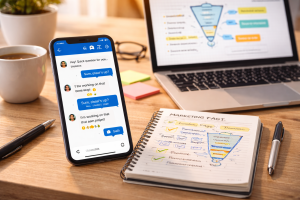
If websites make you want to lie down on the floor and stare at the ceiling, the social DM funnel might be your best friend. This is one of the easiest sales funnels for beginners because it can start with a single social post. You share a useful idea, invite people to message you a keyword, and then send them the resource manually or through simple automation. After that, you continue the conversation and guide them toward a relevant offer.
This approach works especially well for people with smaller audiences because it feels direct and personal. The social DM funnel gets much easier when your posts spark replies in the first place, so these ways to increase social media engagement are a smart companion to this strategy.
Someone sees your post, sends the keyword, receives the resource, and gets a follow up question or next step. For example, you might post, “Want my simple weekly content planner? Send me PLAN and I’ll pass it over.” Once someone reaches out, you send the planner and ask whether they want the matching starter kit or a short walkthrough.
The social DM funnel is also great for testing ideas quickly. Before you spend time building full pages, you can see what people respond to. Which topics get the most messages? Which resource gets the best reactions? Which follow up question leads to genuine conversations? Suddenly, your audience is giving you real time feedback without the need for a giant analytics dashboard that looks like it belongs in a spaceship.
That said, keep it organized. Use a simple script, track who requested what, and make sure the follow up actually feels helpful. Done well, this is one of the most approachable sales funnel examples because it removes a lot of tech friction while still guiding people from interest to action.
Sales Funnels for Beginners 7: The Quiz or Audit Funnel
Among all sales funnels for beginners, quiz funnels often get the most attention because they spark curiosity. People love personalized results. They want to know what type they are, what mistake they are making, or what hidden gap is slowing them down. A short quiz or self audit turns that curiosity into engagement, and then uses the results to recommend the right next step.
A quiz funnel can be as simple as a short form with a few questions and a results page. The goal is not to create a psychological masterpiece that rivals a personality test from a glossy magazine. It is to segment your audience and guide them more accurately.
A short diagnostic style quiz can also help you tailor the follow up message based on the person’s needs. That is one reason newer lead magnet funnel examples increasingly include interactive options like quizzes and audits.
For instance, imagine a quiz called What Kind of Beginner Marketer Are You? The outcomes could be Planner, Overthinker, Content Sprinter, or Shiny Object Collector. Yes, the last one will sting a little, but in a loving way. Each result page can offer a specific recommendation and invite the person to download a relevant guide, join a workshop, or buy a starter product tailored to their type.
This funnel works best when the results feel useful, not gimmicky. People should walk away with insight and direction. In addition, keep the questions easy to answer. If your quiz feels like a university exam, people will vanish halfway through. Short, relevant, and results driven is the way to go.
How to Choose Between These Sales Funnels for Beginners
At this point, you might be thinking, “Great, now I want to build all seven and become a funnel wizard by Monday.” Please resist that urge. The smartest move is to choose one funnel based on your current goal. If you need leads, start with a lead magnet funnel.
If you already have leads but no buyers, consider a low ticket funnel. If you sell a service and need conversations, the PDF to call funnel makes a lot of sense. Meanwhile, if your audience engages heavily on social media, the DM funnel may be the fastest win.
Another good filter is your preferred content style. Love writing? Try the value email series funnel. Comfortable teaching? Go with a mini workshop. Enjoy personalization? A quiz funnel could fit nicely.
The best sales funnels for beginners are not necessarily the most popular ones. They are the ones you can realistically build, launch, and maintain without wanting to throw your laptop into the nearest shrub.
Also, think about your audience’s buying temperature. Cold audiences often respond well to lead magnets and quizzes. Warmer audiences may be ready for a workshop or low ticket offer. Service buyers may need a PDF plus a call to feel confident. In other words, match the funnel to the stage of trust. That is how simple sales funnels become strategic rather than random.
Common Mistakes That Make Sales Funnels for Beginners Feel Harder Than They Are
One classic mistake is trying to say too much. Beginners often cram every feature, every life story, and every possible outcome into one page. However, clarity beats volume. People need to know what the funnel is about, who it helps, and what happens next. That is it. You are not writing a dramatic novel. You are guiding a decision.
Another mistake is creating a mismatch between the front end and the back end. For example, a fluffy motivational freebie followed by a hard sell for a technical service usually feels awkward.
Your funnel should feel like one connected experience. The opt in, emails, and offer should all solve related problems. That smooth progression is one thing many solid sales funnel examples have in common.
Then there is the trap of perfectionism. This one deserves a standing ovation for how many launches it has ruined. Your first funnel does not need to be brilliant. It needs to exist. Start with a clean page, a clear message, and a simple sequence. Then improve it with real feedback.
Many beginner funnel guides still emphasize launching a basic version first because optimization only becomes possible after the funnel is live and collecting real responses.
A Weekend Launch Plan for Sales Funnels for Beginners

If your goal is to build one of these sales funnels for beginners in a weekend, keep the plan simple. On day one, choose the funnel type, define the audience, write the promise, and create the core asset. That asset might be a checklist, a PDF, a mini workshop outline, a small paid product, or a short quiz. Do not get lost polishing tiny details no one will notice. Progress is the mission.
Next, create the main page. This could be a landing page, registration page, or simple sales page depending on the funnel. Write a strong headline, a few benefit driven points, and one call to action. Then build the thank you page and follow up message.
As soon as the basic funnel is live, a few simple marketing automation for beginners setups can save you from manually chasing every follow-up like a caffeinated octopus Even one or two emails are enough to start. Remember, simple sales funnels win because they get launched.
On day two, test the journey from start to finish. Opt in yourself. Check the email delivery. Click the buttons. Read the copy out loud. Fix anything confusing. Then publish and send traffic from one simple source, such as your email list, social posts, profile link, or direct messages. That is plenty for a first version. The point is to learn what happens when real humans touch the thing.
Finally, track the obvious basics. After launch, use a few conversion rate optimization tips for beginners to tweak your headline, button copy, and page flow before you assume the whole funnel is broken.
Are people opting in?
Are they opening emails?
Are they clicking through?
Are they buying or booking?
You do not need a giant tracking fortress. You just need enough information to see what is working. Over time, small improvements stack up. That is how Internet Profit Success actually happens for most people, not through one magical funnel, but through consistent testing and steady refinement.
Final Thoughts on Sales Funnels for Beginners
The best thing about sales funnels for beginners is that they do not require you to become a tech genius overnight. They just require you to understand one person, solve one problem, and guide one next step. That is all a funnel really is. And once you stop treating funnels like some mystical internet machine, they become much easier to build.
So start small. Build the lead magnet funnel if you need leads. Try the low ticket funnel if you want buyers. Use the workshop funnel if teaching is your strength. Go with the PDF to call funnel if conversations close the deal. Use the value email series funnel if your audience needs guidance over time. Try the social DM funnel if you want the fastest, lowest stress setup. And test the quiz funnel if curiosity and personalization fit your niche.
Most importantly, launch before you feel fully ready. You can improve a live funnel. You cannot improve the one still living as an unfinished draft in your head. Pick one of these sales funnels for beginners, build the simplest version you can, and let the real world tell you what to tweak next. That is where momentum starts. And thankfully, momentum is a lot more useful than perfection.
